Top 10 UKG Alternatives: Best APAC WFM Solutions
Introduction: Moving Beyond Traditional WFM Suites
If your organization relies on established HCM suites like UKG, or is actively searching for UKG alternatives, you know their capabilities are substantial. However, the realities of the modern Asia-Pacific (APAC) market often expose the limitations of these global behemoths. Complex, ever-shifting local labor regulations are challenging companies to look for more agile solutions and UKG replacement options.
This guide provides an in-depth, expert review of ten top UKG alternatives. We aim to help you determine if migrating could unlock greater operational efficiency and significantly lower your compliance risk. Our focus will be on how these platforms handle the common pain points experienced by UKG users: implementation time, true functional depth, and essential APAC localization.
Disclaimer: This analysis is based on extensive market research and customer insights. We strongly encourage prospective users to conduct tailored due diligence to find the platform best suited to their organization’s unique operational DNA.
Quick Guide: The Top Alternatives at a Glance
| Alternative | Best For | Core Advantage |
| GaiaWorks | APAC Labor-Intensive Industries (Manufacturing, Retail, Services) | Deep localized compliance, rapid deployment, and verifiable replacement track record. |
| Workday | Large Global Enterprises | Single platform integration for HR, Finance, and Planning. |
| ADP | Complex Multi-Country Payroll Needs | Established global payroll and HR infrastructure. |
| BambooHR | Small to Mid-Sized Teams | Exceptionally intuitive UX/UI for basic HR functions. |
| SAP SuccessFactors | Existing SAP Ecosystem Users | Deep integration with SAP ERP and extensive talent management. |
| Dayforce (Ceridian) | Enterprise HCM with strong payroll integration | Real-time pay and regulatory compliance. |
| Personio | European-focused SMEs | Regional excellence in GDPR compliance. |
| Rippling | Companies Needing HR/IT/Finance Consolidation | Unified system with powerful IT device management. |
| Namely | Mobile-first Distributed Teams | Employee engagement via a seamless social-style interface. |
| Gusto | US Small Businesses | Simplifies and automates payroll processing. |
Evaluating Your Options: Our Criteria for the APAC Market
Choosing WFM software in Asia requires a different set of priorities than those common in Western markets. We structured our evaluation around these critical dimensions:
- Local Compliance and Support: Does the system offer rapid adaptation to the nuances of APAC labor law (e.g., Hong Kong, Singapore, Malaysia)? Crucially, can it provide local expert support that moves at the speed of regulatory change?
- Implementation Speed and TCO: Beyond the upfront licensing fee, what is the realistic Total Cost of Ownership (TCO)? We prioritize solutions that deliver rapid Time to Value over those with year-long implementation cycles.
- WFM Depth and Industry Focus: The platform must go beyond basic time-off tracking. Does it possess the sophisticated AI scheduling and real-time labor tracking features essential for Manufacturing, Retail, and Service?
- Frontline Worker Experience: The system must be loved by the employees who use it daily. A poor mobile interface will kill adoption, regardless of back-end power.
- Integration Ecosystem: Seamless connectivity with existing HRIS, ERP systems (SAP, Oracle, Workday), and local payroll providers is non-negotiable.
In-Depth Review: The 10 Best UKG Alternatives
1. GaiaWorks: The Ideal “Like-for-Like” Replacement for APAC Labor Management
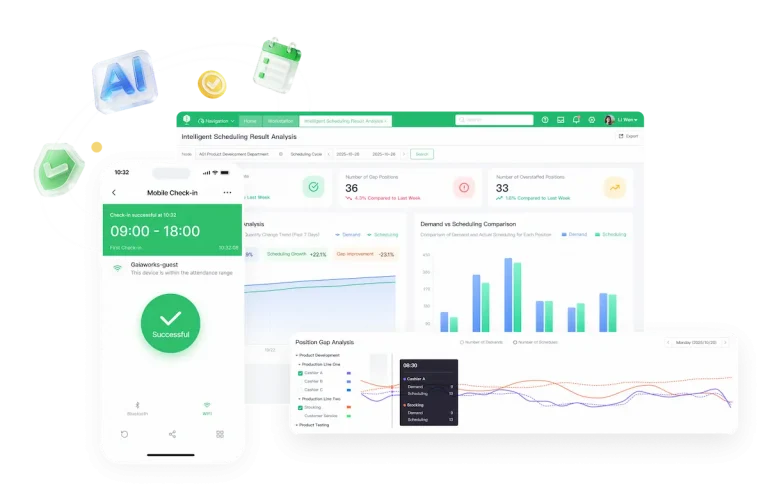
If your operations are rooted in Asia and you need a high-capability WFM solution that cuts the complexity and cost associated with global providers, GaiaWorks is your optimal UKG alternative. Traditional global suites often lock companies into implementation timelines stretching four to six months. In stark contrast, our specialized teams are designed for agility, routinely getting core WFM modules running in just 6 to 8 weeks, guaranteeing a much swifter return on investment. GaiaWorks is a lean WFM specialist engineered to precisely navigate the labor laws in China, Hong Kong, and Southeast Asia.
GaiaWorks Differentiators:
- Deep APAC Localization: Compliance isn’t an add-on; it’s built in. Our platform offers specialized support for complex markets like Hong Kong, Singapore, and mainland China.
- Industry-Focused Optimization: We deliver highly tailored AI scheduling and lean labor tracking for high-volume environments.
- Proven Replacement Success: Our track record of successfully replacing legacy systems—including UKG—validates our functional stability and capability.
- Rapid Deployment & Fairer TCO: We focus on achievable timelines and a transparent TCO more competitive than major international vendors.
- Superior User Experience: Our mobile-first design is intuitive, ensuring high adoption rates among both employees and managers.
2. Workday: The Integrated Enterprise Platform
Workday excels at unifying HR, Finance, and Planning. If your organization is massive (5,000+ employees) and your primary strategic goal is a single-source-of-truth, Workday is a strong candidate. However, budget for substantial implementation time and be aware that adapting its WFM features for deep APAC specificity can be resource-intensive.
3. ADP: The Traditional Payroll and HR Combination
ADP remains a reliable choice for organizations with complex, multi-state or multi-country payroll requirements. While effective, its interface and workflow design often feel dated when compared to newer, more agile WFM platforms.
4. BambooHR: User-friendly Solution for Smaller Teams
BambooHR is known for its simplicity and excellent user experience. However, it may lack the deep WFM functionality (like advanced scheduling optimization) required by large, labor-intensive APAC enterprises.
5. SAP SuccessFactors: HCM Solution for Teams Using SAP
For organizations deeply entrenched in the SAP ecosystem, SuccessFactors offers compelling native integration. It is an enterprise solution that demands significant upfront investment and long implementation timelines.
6. Dayforce (Ceridian): Enterprise HCM with Real-Time Pay
Dayforce is a major competitor to UKG, known for its integrated WFM and payroll capabilities. Its touted feature is the possibility of real-time pay processing.
7. Personio: European-focused Solution for SMEs
Personio has achieved excellence in serving SMEs across Europe, particularly regarding GDPR. Companies expanding into Southeast Asia may find they need to rely on costly integrations.
8. Rippling: Unified HR, IT, and Finance System
Rippling appeals to forward-thinking companies by seamlessly blending HR, IT, and Finance administration. Large APAC organizations should assess whether its WFM specialization is deep enough for granular scheduling.
9. Namely: Mobile-first Platform for Distributed Teams
Namely’s core strength is its mobile-first design. Its functional flexibility for complex scheduling and APAC-specific compliance may lag behind specialized WFM vendors.
10. Gusto: Simple Solution for US Small Businesses
Gusto is primarily focused on making payroll painless for small businesses in the US market. It lacks the necessary scalability and multi-country functionality required by large organizations across Asia.
Comparison Summary: The Best UKG Alternatives
| Alternative | Pricing Tier | Ideal Headcount | Best For |
| GaiaWorks | Mid-Market | 1,000 – 10,000+ | APAC Labor-Intensive Industries, Seeking UKG Replacement |
| Workday | Premium | 5,000+ | Large Enterprises prioritizing HR/Finance integration |
| ADP | Mid-Market | 1,000+ | Complex multi-jurisdictional payroll needs |
| BambooHR | Budget/Mid-Market | 50 – 350 | SMBs looking for extreme simplicity and ease-of-use |
| SAP SuccessFactors | Premium | 5,000+ | Enterprises already committed to the SAP ecosystem |
Critical Factors: What to Prioritize in a New System
When migrating from a global system, your evaluation should prioritize these four critical areas:
- User Experience (UX) and Adoption: The WFM system is used daily by everyone, from the factory floor manager to the retail associate. If the mobile interface isn’t intuitive, simple, and fast, you risk massive adoption failure.
- APAC Compliance Certainty: This is paramount. Can the system confidently handle the complexities of Hong Kong’s statutory holidays, Singapore’s leave calculations, and China’s variable working hours without constant manual overrides?
- Project Risk and Speed: Demand clarity on implementation timelines and local support expertise. You need a partner who can deliver a stable, successful “go-live” well within a fiscal quarter.
- Functional Depth: Ensure the solution moves beyond basic time tracking. It must offer the specific AI optimization and forecasting tools your industry requires to genuinely manage labor as a strategic asset.
The Tipping Point: When to Seek a Change from UKG
It’s time to seriously consider UKG alternatives if your organization is experiencing:
- Growing Compliance Anxiety: Constantly scrambling to manually update rules to keep up with regional changes.
- Unjustifiable TCO: The cumulative cost of maintenance, upgrades, and consulting fees for customization outweighs the functional benefit the system provides.
- Widespread Employee Frustration: Managers and frontline staff are actively avoiding using the system due to a cumbersome interface or unreliable mobile access.
- Operational Inflexibility: The system prevents you from implementing modern workforce strategies like dynamic scheduling or advanced labor forecasting tailored to your specific store or factory model.
Why GaiaWorks is the Premier WFM Partner for Asia
GaiaWorks delivers functional parity with UKG in core WFM, but provides superior value:
1. Proven Success in Retail Optimization
A leading Asian Chain Retail Brand, previously struggling with complex seasonal scheduling and compliance under an incumbent system, partnered with Gaiaworks. By implementing GaiaWorks AI Smart Scheduling module, the client achieved:
A 35% Increase in Store Scheduling Efficiency and elimination of overtime compliance risks, directly contributing to enhanced customer service during peak periods in markets like Hong Kong.
2. Driving Lean Management in Manufacturing
A large Multinational Manufacturing Group replaced their legacy system across APAC facilities. Their main challenge was integrating the WFM system with local piece-rate payroll and complex production systems.
By deploying GaiaWorks’ Real-Time Time Tracking and Lean Analytics, the client achieved a 40% increase in labor analysis accuracy, leading to annual cost savings equivalent to millions in local currency and significantly improved budget control across their China operations.
3. Enabling Rapid Multi-Jurisdictional Expansion
A fast-growing Chain Service Group expanding across Hong Kong and Southeast Asia needed a unified WFM platform capable of handling diverse regional regulations simultaneously.
GaiaWorks provided a unified, multi-regional WFM platform with built-in localized compliance rules. This resulted in deployment in under 3 months, ensuring rapid, compliant expansion with a distinctly lower TCO than that offered by international competitors in the Singapore and wider SEA market.
The GaiaWorks modern WFM approach—focused on maximizing efficiency, minimizing risk, and optimizing TCO—is why over 4,000 Asian enterprises have chosen us as their core labor management platform.
→ Ready to see the difference a focused, local expert can make? Schedule a Demo with our Hong Kong / Southeast Asia Experts today.
A: GaiaWorks provides a robust engine designed to navigate the diverse regulatory landscapes of the Asia-Pacific region. Our solution automates complex labor rule calculations—such as the 713 Ordinance and 468 Rule in Hong Kong, overtime laws in Mainland China, and statutory benefits in Southeast Asia. By digitizing these localized requirements, we help enterprises maintain regulatory compliance, reduce manual errors, and ensure audit readiness across multiple markets.
A: Yes. GaiaWorks is engineered to complement Global HCM (Human Capital Management) systems. We serve as the specialized operational execution layer, focusing on granular time-keeping and intelligent scheduling. Through standard API integrations, we ensure seamless, bidirectional data synchronization with platforms like Workday, SAP SuccessFactors, and Oracle, allowing organizations to maintain a “Single Source of Truth” while optimizing local labor efficiency.
A: We utilize a structured, localized delivery methodology tailored to the unique operational needs of APAC enterprises. Our implementation process involves comprehensive data mapping, compliance configuration, and system testing. Whether through a remote or hybrid delivery model, our regional experts focus on minimizing business disruption and ensuring high user adoption, helping companies transition to digital workforce management with predictable timelines and clear ROI.