
Case Study: How Swire Coca-Cola Solved “Leave Liability” with AI

Case Study: How Swire Coca-Cola Solved “Leave Liability” with AI

Managing factory holidays requires more than just spreadsheets; it demands intelligent AI leave planning. For a giant company like Swire Coca-Cola, balancing production peaks with employee rest was a massive challenge.

They have thousands of workers. They also have distinct seasons. Summer is their busiest production period. However, it is also when employees want to take a break.

This creates a big problem. If too many workers take a holiday in summer, the factory cannot make enough drinks. But if workers do not take breaks at all, the company faces “Leave Liability.”

According to financial standards, unused leave days become a debt on the company’s balance sheet. This creates huge financial pressure. Therefore, Swire Coca-Cola needed a solution.

They stopped using Excel spreadsheets. Instead, they chose GaiaWorks to automate the process with AI leave planning.

The Problem: The “Leave Paradox”

Swire Coca-Cola follows a clear rule: Annual Leave Clearing. Every employee must use all their holiday days by the end of the year.

But in the past, this was difficult to track.

1. Manual work was slow: HR used paper forms and Excel. They could not see the full picture in real-time.

2. Production conflicts: Employees often asked for leave during busy times. Managers had to say “no” at the last minute. This upset the staff.

3. The end-of-year rush: Many employees forgot to take leave until December. Then, everyone wanted to leave at the same time. This threatened production lines.

The company was stuck. They needed to keep the factory running. Yet, they also needed to let people rest.

3D isometric balance scale demonstrating how GaiaWorks AI leave planning balances production peaks with employee vacation.

The Solution: Proactive AI Leave Planning

Swire Coca-Cola introduced the GaiaWorks Smart Annual Leave solution. This system changed the game. It moved from “waiting for requests” to “planning ahead.”

1. The AI Suggests the Best Dates

At the start of the year, the system looks at the Production Forecast. It knows when the factory will be busy.

Then, the AI leave planning engine sends a plan to each employee. It suggests: “Please take your holidays in March or November.” It avoids the busy summer months automatically.

2. The “Semi-Mandatory” Rule

This is the most important part. The system makes sure holidays actually happen.

The system gives employees a deadline. Employees must submit their leave plan by this date. They can accept the AI’s suggestion or pick their own dates (if the dates fit the production plan).

What if they forget?

If an employee does not pick dates by the deadline, the system automatically turns the AI’s suggestion into a formal request. It sends this to the manager for approval.

Consequently, 100% of leave days are planned early in the year. There are no surprises in December.

3. Keeping It Flexible

Robots do not control everything. Humans are still in charge.

  • Employee Choice: If an employee needs to change their dates later, they can. The system allows a “swap.” They can trade their holiday dates, as long as the total number of days stays the same.

  • Manager Control: The AI leave planning tool only gives suggestions. The manager still has the final say. If there is a special emergency, the manager can override the AI.

The Result: A Win-Win

By using AI leave planning, Swire Coca-Cola solved the puzzle.

  • For the Business: The factory always has enough workers. Even during the busy summer, production never stops.

  • For Compliance: The company reduced its “Leave Liability.” Legal risks are gone because all leave is cleared on time.

  • For Employees: They get their holidays guaranteed. They don’t have to fight for dates or get rejected at the last minute.

Swire Coca-Cola proved a key lesson: Good workforce management isn’t just about tracking hours. It’s about planning ahead.

Is your factory facing a leave liability crisis? 
AI in Workforce Management: A 4-Step ROI Guide (2026)

AI in Workforce Management: A 4-Step ROI Guide (2026)

The era of “AI experimentation” is ending. In 2026, the focus on AI in workforce management is shifting. It is no longer about hype. It is about results.

CFOs and HR leaders are asking a hard question: “Where is the money?”

They do not want cool features. They want measurable returns. Therefore, AI in workforce management must optimize the “Time-Skill-Motivation” equation. It must save money and increase efficiency.

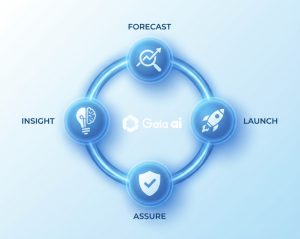
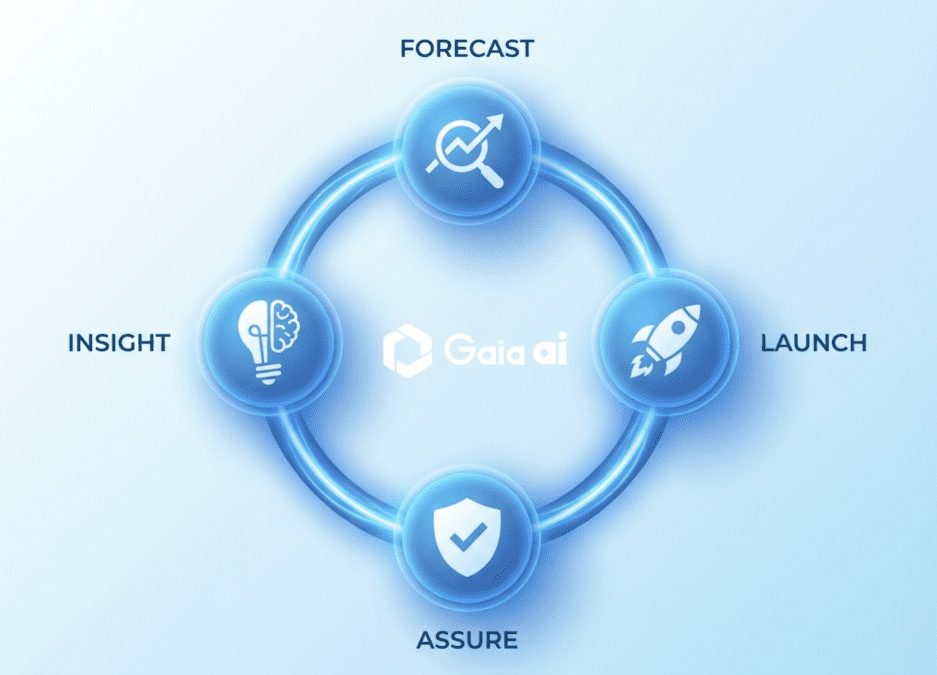
At GaiaWorks, we developed the FLAI Model. This is a practical, four-step framework. It takes your workforce from reactive chaos to proactive optimization. Here is how you can use it to drive real business value.

Infographic illustrating GaiaWorks' four-step FLAI framework: Forecast, Launch, Assure, and Insight, showing how AI in workforce management optimizes operations.

Step 1: Forecast – Predict with Precision

Many retailers still rely on “gut feeling” to build rosters. This is risky. Consequently, they face overstaffing during quiet periods and understaffing during rushes.

GaiaWorks solves this. Our prediction engine uses deep learning to analyze historical data.

  • The Input: It looks at POS data, footfall, and even weather forecasts.

  • The Output: It generates highly accurate labor demand curves.

  • The ROI: You eliminate the “safety buffer.” For example, reducing overstaffing by just 1% significantly improves profit margins. This is the power of AI in workforce management.

Step 2: Launch – Automate Execution

Creating a schedule is a mathematical nightmare. Managers must balance labor laws, employee preferences, and skills. For a human, this takes hours.

However, the “Launch” phase changes this. Our Smart Scheduling Algorithm solves the puzzle in seconds.

  • Multi-Objective Optimization: You set the strategy (e.g., “Cost First”). Then, the AI builds the optimal roster.

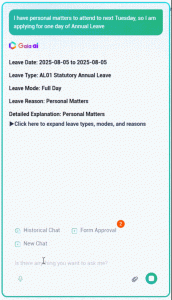
  • The Gaia AI Assistant: We empower employees. An employee simply says to the app, “Help me apply for leave tomorrow.” The AI handles the request instantly.

  • The ROI: This reduces administration time by 90%. Managers can finally focus on customers, not spreadsheets.

Gaia AI assistant interface demonstrating AI in workforce management by automatically converting a natural language chat into a structured leave request form.

Step 3: Assure – Protect with Compliance

In markets with strict Labor Laws, mistakes are expensive. A single oversight can lead to fines.

GaiaWorks acts as your 24/7 internal auditor. This is a critical function of AI in workforce management.

  • Pre-emptive Blocking: The system flags rosters that violate rules before you publish them.

  • Smart Approvals: The AI acts as a gatekeeper. It analyzes overtime requests against real-time data. If it sees a risk, it warns the manager.

  • The ROI: You achieve zero penalties for non-compliance. Furthermore, you strictly control unnecessary overtime costs.

Step 4: Insight – Decide with Data

Traditional dashboards are often confusing. Managers lack the time to dig through spreadsheets.

GaiaWorks introduces ChatBI. This allows you to talk to your data.

  • Ask Your Data: A manager asks, “Why is Store B’s overtime cost high?”

  • Instant Answer: The AI analyzes the data. It replies: “Store B had a 15% increase in sick leave.”

  • The ROI: Decision cycles become faster. You identify and fix cost leaks in minutes, not weeks.

Conclusion: From Bystander to Practitioner

The future of AI in workforce management is not about replacing humans. It is about giving your workforce a “Super-Brain.”

The FLAI model—Forecast, Launch, Assure, and Insight—provides a clear path. It helps you modernize your operations.

In 2026, do not just buy AI. Buy results.

Ready to calculate your ROI? 

The High Cost of “Rubber Stamping”: How AI Smart Approval Safeguards Your Bottom

The High Cost of “Rubber Stamping”: How AI Smart Approval Safeguards Your Bottom

Introduction: The “Approve All” Trap

In the fast-paced world of workforce management, HR compliance automation is becoming essential. Notifications bombard managers daily. Overtime requests, leave applications, and shift swap forms fill their screens.

Pressed for time, many managers fall into a dangerous habit: hitting “Select All” and “Approve.”

In the industry, we call this “Rubber Stamping.” It refers to approving administrative requests without meaningful review. However, this “auto-approve” culture is a silent leak in your organization. It causes damage in two critical areas:

1. Financial Leakage: You pay for overtime that was never worked.

2. Compliance Risk: You inadvertently allow breaches of labor laws.

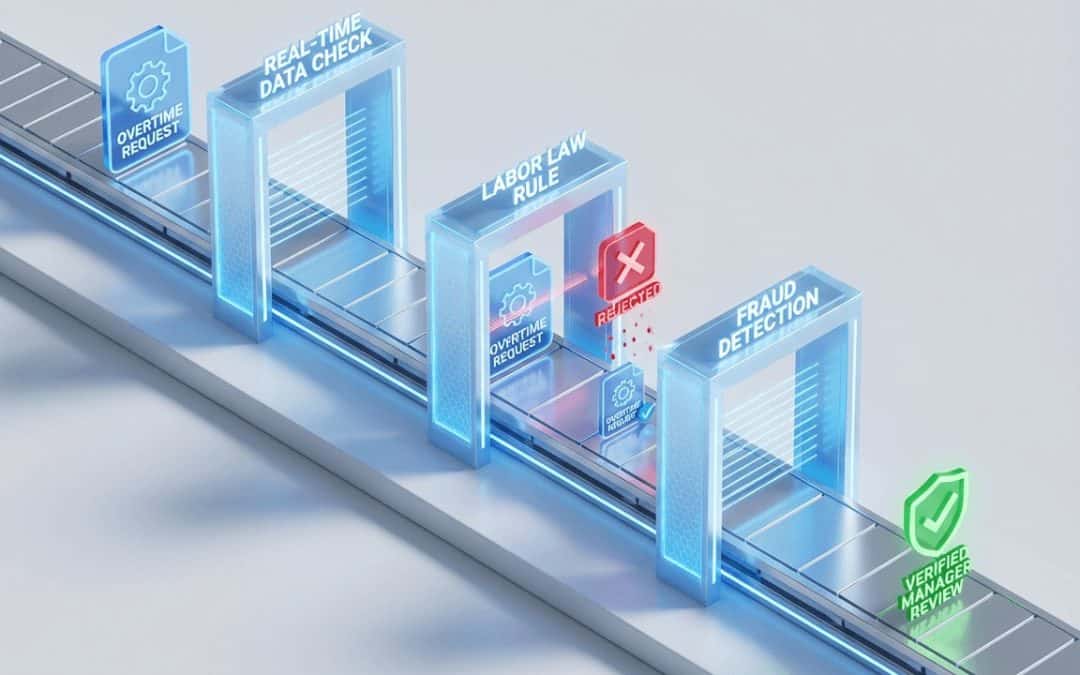
At GaiaWorks, we believe technology should solve this. Therefore, we developed AI Smart Approval. This tool delivers powerful HR compliance automation by verifying requests before they ever reach a manager’s desk.

GaiaWorks HR compliance automation software blocking rubber stamp approvals

Moving Beyond Digitization to Intelligence

Traditional HR systems simply moved the problem from paper to a screen. GaiaWorks is different. Our system employs Artificial Intelligence to verify the facts behind every request.

Consequently, the workflow shifts from “Manager Audit” to “System Audit.” Here is how HR compliance automation protects your business in three specific ways.

1. Real-Time Data Checks Drive HR Compliance Automation

Imagine an employee submits a request for 4 hours of overtime. They claim they worked until 10:00 PM. In the past, a manager had to blindly trust this claim.

Now, GaiaWorks AI automates this verification. It instantly cross-references the request with objective data sources, such as door access logs.

  • The Scenario: An employee requests pay until 10:00 PM. However, the access control system shows them exiting the building at 6:00 PM.

  • The AI Action: The system flags the discrepancy immediately. It alerts the manager: “Warning: Attendance data does not match the claimed hours.”

  • The Result: You reject the request instantly. Thus, you prevent payroll leakage before it happens.

    2. The Safety Net: How HR Compliance Automation Protects You

    Labor regulations are becoming increasingly complex. For instance, according to standard Labor Laws, it is often illegal for an employee to work too many consecutive days without a break.

    Human managers often lose track of these cumulative counts. The AI, however, never forgets.

    • The Scenario: A manager attempts to schedule a willing worker for a Sunday shift.

    • The AI Action: The system analyzes the worker’s recent schedule. It identifies that they have already worked six consecutive days.

    • The Result: The system blocks the request automatically. It says: “Request Denied: Violation of Maximum Consecutive Working Days.”

    This proactive block keeps the company safe from regulatory fines.

    3. Intelligent OCR Enhances HR Compliance Automation

    dministrative friction often occurs when employees need to submit physical evidence, such as a doctor’s note. Traditionally, HR teams read these documents manually. This is a slow process.

    GaiaWorks utilizes advanced Optical Character Recognition (OCR) technology.

    • The Capability: The AI “reads” the uploaded photo of the medical certificate.

    • The Verification: It extracts key data points, such as dates. Then, it matches them against the leave request.

    • The Result: If the dates do not align, the system alerts the HR team.

    Conclusion: Management by Exception

    The goal of HR compliance automation is not to replace managers. Instead, it empowers them. By filtering out non-compliant requests, the system allows leaders to practice “Management by Exception.”

    • For Managers: The fear of accidental non-compliance vanishes. They spend less time auditing timesheets.

    • For the CHRO/CFO: You gain peace of mind. You know that every dollar spent on overtime is verified.

    Stop “rubber stamping.” Let AI handle the verification.

    Is your organization ready to close the gap on compliance risk? Contact with GaiaWorks today to see our Smart Approval engine in action.