How to Improve Employee Attendance at Work: 7 Practical Ways
Employee absenteeism is often treated as an HR problem, but for labor-intensive operations it quickly becomes a business performance issue. According to research from the CDC Foundation and Circadian, the annual cost of unscheduled absenteeism in the U.S. alone tops $225 billion, or roughly $3,600 per hourly worker every year.
For companies that rely on frontline, hourly, or shift-based teams, poor attendance can slow production lines, increase overtime costs, reduce service quality, and push reliable employees toward burnout. To improve employee attendance at work, companies need more than stricter policies. They need predictable scheduling, transparent attendance rules, easy mobile communication, accurate time tracking, and real-time visibility into coverage gaps.
This guide explains why attendance problems happen and how employers can reduce absenteeism across frontline teams without creating more administrative work for managers.
Quick Answer: How to Improve Employee Attendance at Work
The best way to improve employee attendance at work is to combine fair scheduling, clear absence policies, mobile self-service, accurate time tracking, real-time absence alerts, and transparent incentives. Attendance improves when employees know their schedules in advance, can request leave or shift swaps easily, and trust that working hours, overtime, and attendance-related incentives are calculated correctly.
Why Employee Attendance Problems Happen
Poor employee attendance is rarely caused by one single issue. In frontline operations, absence patterns usually come from a mix of schedule instability, fatigue, unclear rules, communication delays, and weak visibility into workforce demand.
Common causes include:
- Unpredictable shifts or last-minute roster changes
- Excessive overtime and physical fatigue
- Slow leave approval or unclear absence reporting
- Limited visibility into shift swaps and replacement coverage
- Inaccurate time tracking across sites or mobile teams
- Low trust in payroll, overtime, or incentive calculations
- Managers relying on spreadsheets instead of real-time workforce data
Before employers can improve attendance, they need to understand which of these issues is driving absence in each team, site, or region.
1. Build Fairer Schedules Before Absence Happens
Attendance problems often start before an employee misses a shift. If schedules are unpredictable, overly compressed, or disconnected from employee availability, absence risk rises quickly.
In manufacturing and other labor-intensive environments, demand can change fast. When production spikes, line managers may try to fill gaps manually across multiple teams or lines. This can create excessive overtime, fatigue, unfair shift distribution, and last-minute coverage issues.
A better approach is to use demand-based workforce planning. Managers should align labor supply with production demand, employee availability, skills, rest rules, and overtime limits. This helps prevent burnout before it becomes absenteeism.
For example, when Swire Coca-Cola digitized its complex labor-sharing logic with GaiaWorks, the team reduced weekly scheduling time to just 10 minutes and gained clearer visibility into leave balances. The result was not only lower scheduling pressure, but also a 2% boost in overall production capacity.
2. Make Leave Requests and Shift Swaps Easier
Some no-shows happen because employees do not have a simple way to report an emergency, request leave, or swap a shift. This is especially common in retail, hospitality, food service, and other fast-moving environments where staff are rarely sitting at a desk.
To improve employee attendance at work, companies should make schedule communication mobile-first. Employees should be able to check upcoming shifts, request leave, confirm changes, and manage approved shift swaps from their phones.
When the process is easy, employees are more likely to communicate early instead of missing a shift without notice. Managers also get more time to adjust coverage before service quality is affected.
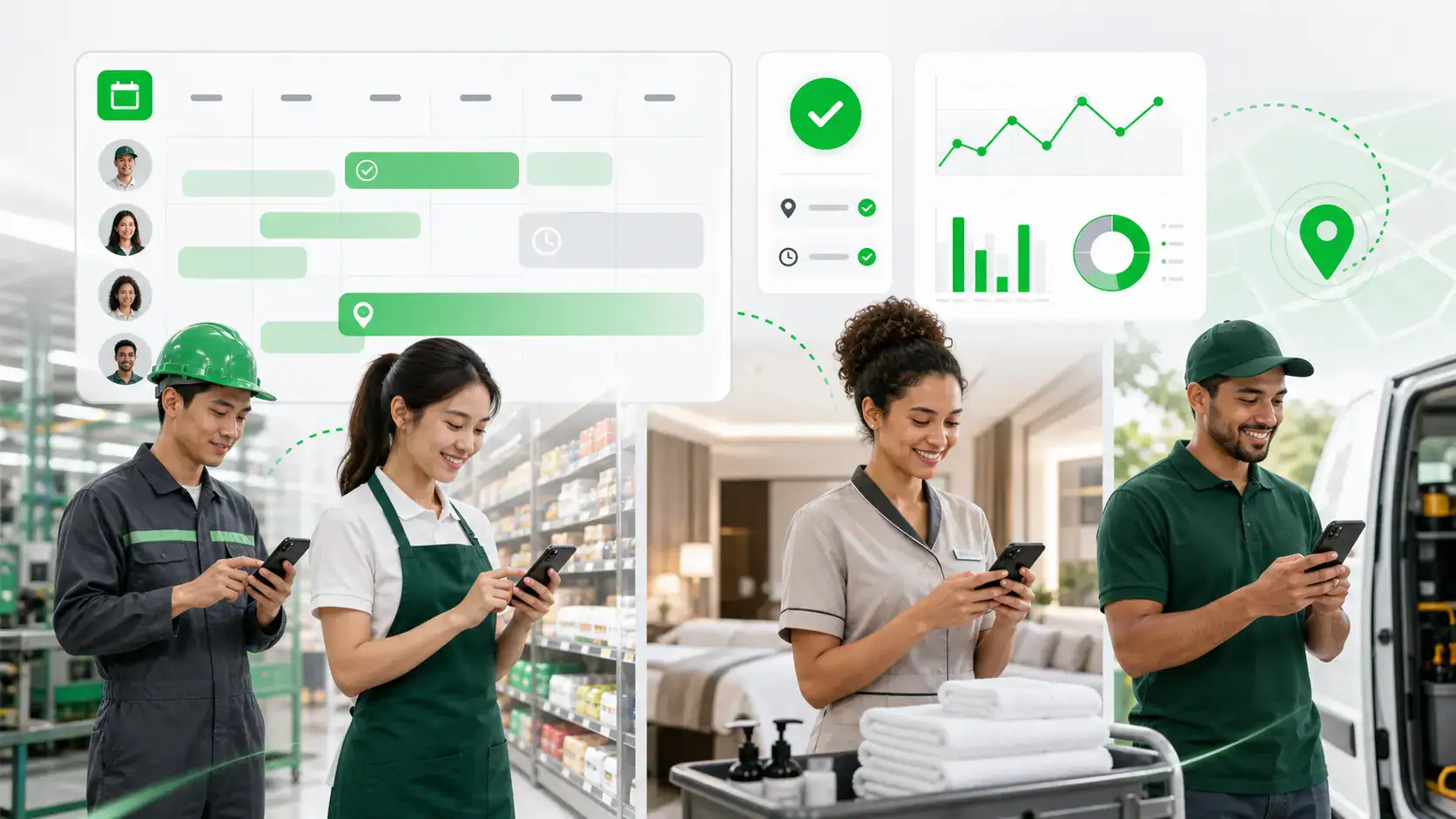
With the GaiaWorks mobile app, frontline employees can view schedules, request leave, and manage peer-to-peer shift swaps directly from the shop floor. Native language support also helps reduce communication barriers for diverse regional teams.
3. Use Accurate Time Tracking Across Sites
Attendance data is only useful if it is accurate. For distributed teams such as logistics workers, construction crews, field service employees, and facility management staff, traditional punch cards or manual sign-in sheets can create blind spots.
Inaccurate time tracking can lead to buddy punching, missed punches, payroll disputes, and unclear absence data. It also makes it harder for managers to know whether a worker is late, absent, or assigned to another site.
Location-based attendance tracking helps solve this problem. GPS, Bluetooth, dynamic QR codes, and geofencing can verify that employees clock in at the right location and at the right time.
GaiaWorks supports second-level precision attendance tracking through GPS, Bluetooth, and dynamic QR code methods. If a worker misses a punch, line leaders can receive an instant alert at shift change, giving them time to respond before the absence disrupts operations.
4. Set Clear Attendance Rules and Apply Them Consistently
Employees are more likely to follow attendance policies when the rules are clear, consistent, and easy to understand. If policies are vague or applied differently across managers, employees may not know what counts as late arrival, no-show, approved leave, emergency absence, or overtime.
Clear rules should define:
- How far in advance employees should report absence
- Which absence reasons require documentation
- How late arrivals and early departures are handled
- How shift swaps are approved
- How overtime, rest time, and attendance incentives are calculated
- What happens after repeated unplanned absence
For multi-site or multi-country operations, these rules also need to reflect local labor laws. A centralized workforce management system can help managers apply policies consistently while still respecting local compliance requirements.
5. Connect Attendance with Labor Compliance
In industries such as healthcare, pharmaceutical manufacturing, transportation, and large-scale manufacturing, attendance issues can create compliance risk. If a site falls below required staffing levels, or if replacement shifts violate rest-period or overtime rules, the business may face operational and legal consequences.
That is why attendance management should be connected with scheduling compliance. Managers should not have to manually check every replacement shift against local labor regulations.
GaiaWorks operates across 34 countries and includes a built-in rule engine that helps block non-compliant scheduling before it happens. This supports better attendance planning while reducing the risk of accidental labor rule violations.
6. Link Attendance Data to Labor Costs
For construction, facility management, and field services, attendance is directly tied to project cost control. Companies need to know not only whether someone worked, but also where they worked, which task they completed, and which project or cost center should absorb the labor cost.
If attendance data is disconnected from project codes or downstream systems, managers may struggle to control labor budgets. Verified attendance should flow into payroll, ERP, HCM, and cost allocation systems as a trusted data source.
With GaiaWorks, field workers can log verified hours against specific project codes using mobile geofencing. Attendance data can then flow into systems such as SAP or Workday, helping prevent budget overruns and ensuring teams pay only for verified on-site hours.
7. Reinforce Good Attendance with Transparent Incentives
Attendance policies often focus on penalties, but penalties alone rarely build long-term engagement. In frontline teams, employees are more likely to respond positively when attendance is connected to fair pay, visible performance metrics, and achievable incentives.
Transparent incentive programs can reward reliable attendance, productivity, output quality, or shift flexibility. The key is making the rules easy to understand and the calculations trustworthy.
GaiaWorks can connect production and attendance data to incentive calculations. By pushing performance metrics and wage incentives directly to a worker’s mobile device, companies can make attendance part of a shared productivity goal rather than only a disciplinary requirement.
How Workforce Management Software Helps Improve Attendance
Workforce management software helps improve employee attendance by connecting schedules, leave, time tracking, compliance rules, labor cost data, and manager alerts in one system. This gives operations teams a more complete view of where attendance issues are happening and what actions can prevent them.
For frontline organizations, the most useful capabilities include:
- Demand-based scheduling to reduce fatigue and overstaffing
- Mobile schedule access, leave requests, and shift swaps
- GPS, Bluetooth, QR code, or geofenced clock-in options
- Real-time missed-punch and absence alerts
- Built-in labor compliance rules
- Integration with payroll, ERP, HCM, and cost systems
- Analytics to identify absence patterns by site, role, or team
The goal is not only to track attendance after the fact. The goal is to prevent avoidable absence before it disrupts operations.
Ready to Improve Attendance Across Frontline Teams?
Improving employee attendance at work requires a practical balance of policy, planning, communication, and technology. Companies need to make schedules fairer, give employees easier ways to manage absence, track time accurately, and help managers respond before small coverage issues become operational problems.
As a certified calculation engine for leading HCM systems such as SAP and Workday, GaiaWorks helps enterprises standardize attendance, scheduling, compliance, and labor cost management across APAC and other complex operating regions.
Book a demo with GaiaWorks to see how your frontline teams can reduce absenteeism, improve attendance visibility, and run more reliable operations.
FAQ
Can workforce management software improve employee attendance?
Yes. Workforce management software can improve employee attendance by connecting scheduling, leave management, time tracking, compliance rules, and labor cost data in one system. It helps managers prevent avoidable absence and respond faster when coverage gaps appear.
For frontline and shift-based teams, GaiaWorks supports this by combining demand-based scheduling, mobile attendance, leave workflows, real-time alerts, and compliance rules across multiple sites and countries.
Why is mobile attendance important for shift-based teams?
Mobile attendance is important because shift-based employees often work across different locations or outside office environments. Mobile tools let employees check schedules, clock in, request leave, receive updates, and manage approved shift swaps without relying on paper forms or manual manager follow-up.
GaiaWorks supports mobile attendance through GPS, Bluetooth, QR code, and geofenced clock-in options, helping managers verify attendance accurately across stores, plants, project sites, and field locations.
What attendance metrics should employers track?
Employers should track unplanned absence rate, late arrivals, missed punches, overtime hours, shift-swap frequency, absence reasons, coverage gaps, and absenteeism trends by site, department, role, and manager. These metrics help identify whether attendance issues are caused by scheduling, communication, fatigue, or policy gaps.
With GaiaWorks, these attendance metrics can be connected with scheduling, payroll, labor cost, and compliance data, giving operations and HR teams a clearer view of attendance risk across frontline teams.