
Frontline Shift Stabilization: Protecting Operational Margins in Complex Labor Markets
Operating a cross-border, labor-intensive enterprise across region presents a high-stakes operational puzzle. Floor managers must scale labor capacity dynamically in response to erratic, real-time consumer demand fluctuations while simultaneously operating within localized regional frameworks—from Singapore’s Employment Act Part IV limits on weekly hours to Hong Kong 417/468 rules. When these forces pull in opposite directions, localized managers spend hours manually balancing spreadsheets instead of driving floor productivity.
When these forces clash, the friction is absorbed entirely by the frontline schedule.
Volatile schedules destroy labor margins. For years, organizations treated the roster as a simple administrative output—a weekly puzzle solved by localized managers using legacy spreadsheets. In the current economic environment, this approach is a major operational liability. Unstable shift patterns trigger a compounding cycle of workforce fatigue, compliance exposure, brand erosion, and operational friction.
To break this cycle of operational friction, global enterprise leaders are pivoting toward a strategic operational framework: Frontline Shift Stabilization. This approach moves scheduling from a clerical guessing game to a disciplined algorithmic system designed to balance labor capacity with human recovery. A system designed to maximize labor utilization, eliminate idle hours, and give supervisors their time back.
The Macro Shift: Why Stability Is the New Flexibility
The global labor market has entered a mature phase of risk mitigation. The historical volatility of peak talent acquisition cycles has quieted into a pattern labor economists call “Job Hugging.” Frontline employees in manufacturing, logistics, and retail operations are no longer executing high-risk transitions for marginal wage increases. Instead, they are prioritizing security, predictability, and schedule continuity.
This behavioral shift is driven by economic reality:
- Squeezed Bandwidth: Financial strain directly narrows cognitive focus. Industry studies indicate that approximately 74% of frontline workers state that personal financial stress impacts their productivity and focus on the floor.
- The Predictability Mandate: Scheduling has become a primary recruitment and retention metric. More than 37% of deskless workers state they would outright reject an employment offer that does not provide advance schedule visibility. This friction is validated by recent global data from JLL’s The Forgotten Workforce study, which reveals a stark structural disconnect: while 47% of frontline operators express a critical need for schedule flexibility, barely over a third have access to it under current legacy management frameworks.
For global enterprises, these statistics highlight a clear operational risk. If an organization’s scheduling model remains chaotic and reactive, its workforce becomes distracted, disengaged, and highly prone to voluntary exit. In labor-intensive environments, a minor 5% spike in employee attrition triggers a cascade of compounding costs: increased overtime premiums, slower line ramp-up speeds, onboarding overhead, and heightened safety vulnerabilities during transition phases.
The strategy for managing labor in this environment is clear. It is no longer about aggressive talent acquisition; it is about systemic risk containment through structured shift stabilization.
The Vulnerability Loop: The Cost of Scheduling Volatility
When scheduling fails, the consequences manifest rapidly across every tier of the enterprise. This vulnerability is highly visible in high-growth, high-intensity service environments.
Consider the operational failure cascade of a hyper-growth artisanal coffee chain in Asia that rapidly scaled to hundreds of locations. To protect margins during rapid expansion, the company relied on lean staffing models and manual shift configurations. Because the preparation of artisanal beverages requires complex, manual procedures, employees were subjected to intense physical and cognitive fatigue.
The lack of predictive, stable scheduling led to chronic understaffing during peak morning spikes. Workers, physically drained by erratic shift rotations and back-to-back schedules, experienced severe burnout. This internal operational friction quickly became external. The company faced multiple high-profile, documented altercations between exhausted staff and customers on the retail floor. The resulting social media backlash damaged the brand’s premium market positioning, triggered a wave of retail staff resignations, and invited regulatory scrutiny regarding its labor compliance and overtime policies.
This is the vulnerability loop in action:
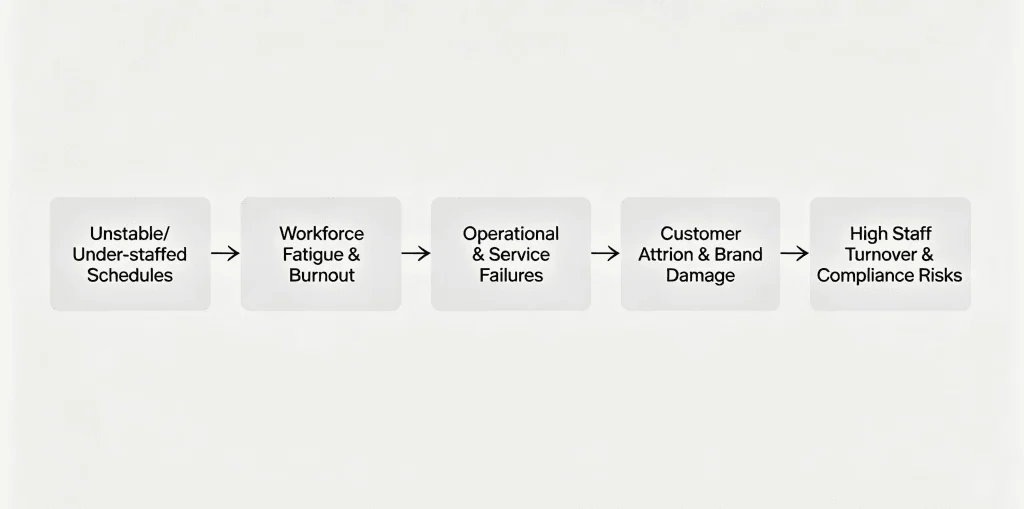
When scheduling is volatile, the service standard degrades. Frontline employees are the primary touchpoint for consumer experience; if they are exhausted by unpredictable shift structures, service quality drops, wait times increase, and brand equity erodes.
Furthermore, this volatility introduces significant legal and financial exposure. Operating without automated, rules-based scheduling guardrails makes it incredibly easy to breach localized labor codes, resulting in wage-and-hour lawsuits, compliance penalties, and public labor disputes that alienate institutional investors.
Architectural Solution: System of Record vs. System of Engagement
Why do traditional software deployments fail to solve this problem?
The disconnect lies in the architecture of the enterprise technology stack. Most multinational organizations rely heavily on legacy Core Human Capital Management (HCM) systems or Enterprise Resource Planning (ERP) databases. These platforms are built to serve as Systems of Record. They excel at archiving contracts, processing monthly payroll, and maintaining static headcount ledgers for global compliance.
However, a System of Record is too rigid to manage the dynamic reality of the shop floor or the retail outlet. It cannot resolve an unexpected absenteeism spike at 6:00 AM, nor can it dynamically recalculate labor sharing opportunities across three distinct suburban retail flagship stores based on midday foot traffic data.
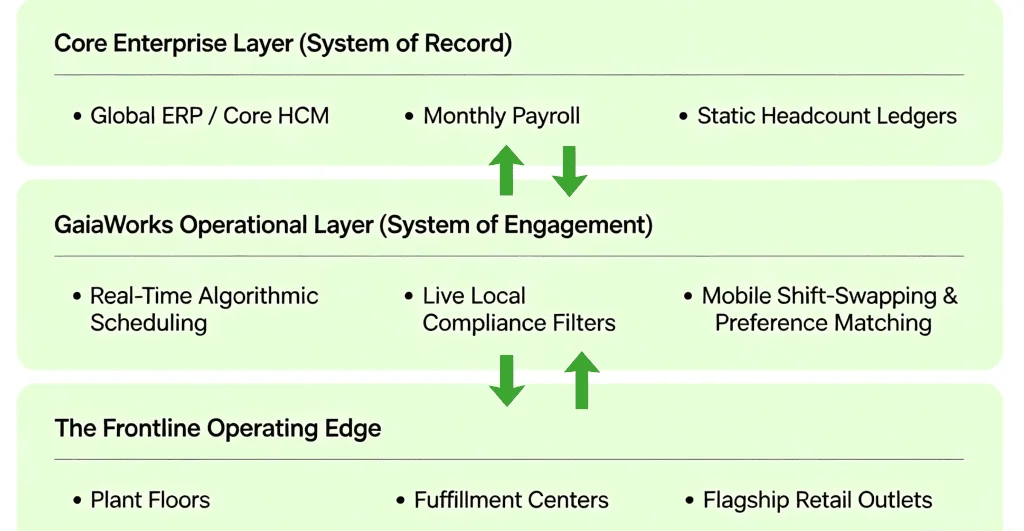
To achieve frontline shift stabilization, enterprises must deploy a System of Engagement that sits directly on top of the Core HR database. A specialized workforce management platform acts as this engagement layer, providing the real-time operational flexibility needed to execute shifts smoothly.
While the Core HR system records who is employed, the System of Engagement optimizes how they work, translating live operational data into immediate scheduling adjustments. This real-time focus allows operations to move at the speed of continuous improvement, resolving issues on the floor before they turn into costly delays or labor disputes.
The 5 Pillars of Algorithmic Shift Stabilization
To build a reliable scheduling process, global organizations must design their rosters around five core, automated workflows:
1. Circadian and Rest Buffering
Human fatigue directly impacts factory throughput and retail service quality. Instead of leaving shift sequencing to manager guesswork, an stabilized scheduling system automatically calculates biological recovery windows alongside local rest mandates. By programmatically preventing back-to-back “clopening” shifts (where an employee closes a facility late at night and opens it early the next morning), compliance becomes an invisible safety net running in the background. Operations are protected from costly line-slowdowns and safety incidents, long before data ever hits the payroll stage.
2. Granular Preference Alignment
Top-down scheduling mandates create friction. A stabilized scheduling system uses mobile-first worker applications to let employees log their shift preferences (e.g., preferred morning/afternoon blocks or specific weekend availability). The scheduling algorithm then automatically cross-references these preferences with anticipated labor demand. While matching 100% of preferences is statistically impossible, prioritizing these preferences in the automated roster build dramatically lowers voluntary turnover.
3. Systemic Work-Hour Equalization
In manual scheduling environments, shifts are often distributed unevenly. Favored employees receive premium hours, while others struggle to secure their baseline contract hours. This inequality causes resentment and turnover. Algorithmic equalization monitors cumulative monthly work hours across the entire workforce. The system automatically routes open shifts to under-utilized contract staff first, ensuring fair earnings, preventing fatigue-related overtime premiums, and reducing overall labor spend.
4. Dynamic Incentive and Performance-Linked Scheduling
Peak operating hours require high-performance talent. To optimize service and production during high-demand windows, the system links scheduling engines with performance data. High-performing or multi-certified employees are dynamically scheduled for high-traffic blocks. Additionally, the system automatically calculates premium holiday allowances, night-shift differentials, and cross-site support bonuses, ensuring that workers are paid accurately and rewarded transparently for taking on challenging shifts.
5. Cross-Line and Cross-Location Labor Sharing
Static schedules trap labor in silos. If Plant Line A is experiencing a seasonal lull while Plant Line B is struggling with an unexpected order surge, manual scheduling systems struggle to reallocate staff in time. By maintaining a centralized, verified database of employee skills and compliance certifications, the system dynamically suggests qualified, available internal staff to cover shortages across lines or even across nearby retail locations. This maximizes internal labor utilization, avoids expensive temporary agency hiring, and gives workers more options to pick up extra shifts.
Global Enterprise Validation: Empirical Outcomes
Frontline shift stabilization is not a theoretical HR initiative; it is a proven driver of operational efficiency and cost control. When APAC and global enterprises deploy these structured scheduling systems, the operational improvements are immediate:
Manufacturing: The Global Beverage Bottler
A premier global beverage bottling enterprise’s manufacturing facility was struggling with complex manual scheduling. Managing various production lines, seasonal volume swings, and high-skill labor requirements took supervisor teams several hours each week.
- The Solution: The plant deployed automated scheduling, turning complex labor rules into simple, algorithmic calculations.
- The Result: Weekly scheduling admin time dropped from 4 to 6 hours down to just 5 minutes. Overall production capacity climbed by 2%, and employee scheduling complaints dropped to zero.
Retail: The Multi-Store Athletic Brand
A leading multinational athletic brand with 50 regional flagship locations faced high store manager burnout and low staff retention due to inconsistent, manual retail rosters.
- The Solution: Stores launched localized, demand-driven scheduling that automatically built schedules based on historical store traffic patterns and worker preferences.
- The Result: Within a 12-week deployment cycle, overall workforce efficiency optimized by 12%, and consumer satisfaction metrics grew by 8%, freeing store managers from late-night scheduling stress.
Service: The Omnichannel Customer Service Node
A large-scale customer service center managing continuous multi-channel operations was seeing high agent burnout and employee turnover, particularly on overnight shifts.
- The Solution: The center introduced automated rest-buffering rules and digital shift-swapping features, giving agents more control over their schedules.
- The Result: Employee fatigue on overnight shifts dropped by 40%, directly contributing to a 20% drop in agent turnover.
Building a Resilient Workforce Strategy
In the modern operational landscape, managing workforce scheduling manually is no longer sustainable. Unstable schedules create a constant cycle of employee fatigue, service drops, and high turnover, all of which eat away at profit margins.
By upgrading from a static Core HR System of Record to an agile System of Engagement, global enterprises can design stability directly into their operations. This approach protects margins, maintains compliance, and turns scheduling from an administrative headache into a true competitive advantage.
Optimize your workforce operations today. Contact GaiaWorks to discover how our smart scheduling and algorithmic solutions can bring stability to your frontline teams.
A Great Workforce, Gaia Works.