Multi-Site Retail Attendance: Cut Labor Cost Before Payroll
Multi-site retail attendance data often tells the labor-cost story before payroll does.
Many retailers still look at manpower cost too late. By the time payroll closes, the labor cost has already happened. The missed clock-in has been corrected. The late arrival has been approved. The extra hour has become payable time. The store manager has already called in another worker, extended a shift, or accepted a service gap because the floor still needed coverage.
That is why attendance matters.
Not because attendance alone reduces headcount. It does not. Scheduling decides where labor should go. Attendance proves where labor actually went.
For retailers with thin margins, that difference matters every week.
Retail Labor Cost Is Built Store by Store, Shift by Shift
Retail manpower planning is difficult because demand rarely moves in a straight line. A chain store may look stable at monthly level, while each site lives through a different pattern: weekend peaks, lunchtime rushes, weather effects, promotion periods, tourist flows, local events, stock delivery windows, and quiet hours where too much coverage quietly eats margin.
Hong Kong’s retail market shows this volatility (Provisional Statistics of Retail Sales for May 2026). The Census and Statistics Department reported that total retail sales in May 2026 were provisionally estimated at HKD 33.8 billion, up 7.9% year on year, while online sales accounted for 10.1% of total retail sales value and rose 32.3% year on year. Growth is good news. It also makes store labor planning more sensitive, because demand shifts by category, channel, and location.
The Same Pattern Appears Across APAC Retail
Singapore’s Department of Statistics tracks retail sales and online retail sales on a monthly basis, reflecting how store demand now moves across physical and digital channels. Japan’s Ministry of Economy, Trade and Industry tracks retail activity across department stores, supermarkets, convenience stores, drugstores, and other large-format retail categories.
For workforce leaders, the message is practical: retail demand is not only volatile by country. It is volatile by store format, channel, location, calendar, and daypart. A supermarket, beauty counter, pharmacy chain, convenience store, and department store may all need different labor patterns, even under the same retail group.
That is why attendance data matters. It gives retailers a common operating record across formats and markets: who was scheduled, who actually worked, where overtime appeared, where coverage failed, and which stores paid for hours that did not match demand.
For GMS, supermarkets, convenience stores, pharmacy chains, beauty retailers, apparel brands, and F&B operators, the labor question is not simply “how many people do we employ?”
The better question is:
Are paid hours matching real store demand?
Scheduled Hours Are Not the Same as Actual Labor Cost
A weekly roster can look controlled. The budgeted hours are within target. The store has enough names on the plan. The part-time mix looks reasonable.
Then execution starts.
Someone arrives 18 minutes late. Another employee stays past the scheduled end time because the closing task is not finished. A supervisor approves extra time after a delivery delay. A part-timer swaps into a shift with a different cost profile. A missed punch gets corrected manually. A store appears covered on the roster, but the actual in-store hours do not match the planned coverage.
None of these issues may look dramatic. Together, they create payroll leakage.
This is why Time & Attendance should not be treated as back-office administration. In retail, attendance is the operating record that connects store execution to labor cost.
What Attendance Data Reveals Before Payroll
Attendance data becomes useful when it is connected to schedules, store hierarchy, employee type, overtime rules, and cost centers. Otherwise, it is just a clock-in archive.
For retail leaders, the most valuable attendance signals are usually simple:
- Actual working hours versus scheduled hours
- Late arrivals and early departures
- Missed punches and manual corrections
- Absenteeism and no-shows
- Unplanned overtime
- Employees approaching overtime thresholds
- Store-level attendance exceptions
- Worked hours by department, role, task, or cost center
- Planned labor cost versus actual labor cost
- Schedule adherence by store and manager
These signals tell operations where the plan is breaking. They also tell finance whether the labor budget is being controlled before payroll, or merely explained afterward.
The Attendance-First Approach
Attendance-first does not mean attendance is more important than scheduling. It means retailers should use verified actual-hour data as the first source of truth before making manpower decisions.
A practical attendance-first approach works like this:
| Question | What Attendance Data Shows |
|---|---|
| Are stores truly overstaffed? | Actual hours by store, daypart, role, and demand pattern |
| Is overtime caused by real demand or poor execution? | Approved overtime versus actual worked time |
| Are part-time hours being used well? | Utilization by employee type and store |
| Where do schedules fail most often? | Late arrivals, absences, missed punches, and replacement patterns |
| Which stores need support, not cuts? | Coverage gaps during peak demand |
| Which stores carry hidden waste? | Idle hours, repeated early clock-ins, or low-output labor periods |
This is a better starting point than cutting manpower based on headcount or scheduled hours alone. A store may need fewer hours in one daypart and more qualified workers in another. Another store may not have a headcount problem at all; it may have an attendance reliability problem, a scheduling accuracy problem, or a manager override problem.
The cost opportunity sits in the detail.
Where Retailers Usually Find Labor Cost Leakage
Retail labor cost leakage is rarely one big mistake. It is usually a pattern.
Unplanned overtime
Overtime often appears when attendance and scheduling are disconnected. A store may publish a compliant roster, but actual attendance changes during the week. If managers cannot see overtime risk until payroll, the control window has already closed. This is why overtime should be managed as a scheduling and attendance issue, not only a payroll issue. GaiaWorks covers this in more detail here: Why Frontline Overtime Is Often a Scheduling Problem.
Phantom coverage
The roster shows coverage, but the floor does not. A person is scheduled but absent, late, assigned elsewhere, or not qualified for the task that needs support. Attendance clarity helps separate planned coverage from real coverage.
Idle paid time
Some stores may carry excess labor in quiet periods because staffing rules are based on averages, habit, or manager preference. Actual-hour data, when compared with traffic and sales, helps identify where hours can be redeployed instead of simply reduced.
Manual corrections
Missed punches, paper records, delayed approvals, and manual edits increase administrative time and weaken trust in payroll data. They also make it harder to compare stores fairly.
Wrong cost allocation
In multi-store retail, employees may support nearby locations or tasks. If worked hours are not allocated to the right store, department, or cost center, finance sees labor cost but not the real operating reason behind it.
Attendance Data Should Feed Better Scheduling
The best labor-cost improvements happen when attendance data flows back into scheduling.
A store that repeatedly runs overtime on Friday evenings may need a different demand forecast, a stronger part-time pool, or adjusted closing coverage. A site with frequent late arrivals may need different shift start logic or a more reliable labor source. A store with stable low-traffic hours may be able to redeploy hours to another location without harming service.
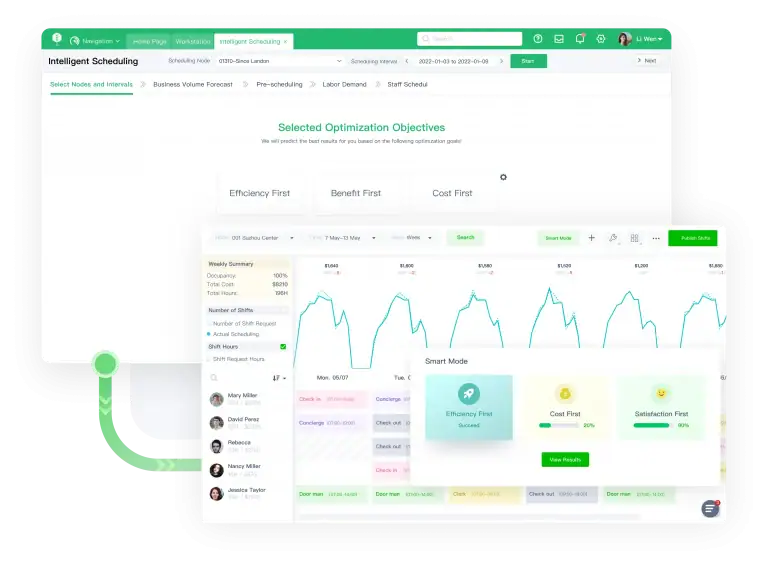
That is where GaiaWorks’ retail workforce management approach becomes relevant: demand signals, scheduling, attendance, labor cost, and store performance need to work in one operating view. Retail scheduling can then use sales, traffic, promotions, operating periods, employee availability, skills, working-time rules, and attendance history to make better decisions.
The goal is not to cut blindly.
The goal is to reduce wasted hours while protecting service capacity.
What a Retail Attendance System Should Support
Retailers evaluating attendance systems for cost control should look beyond clock-in methods. The system needs to support store operations, not just time capture.
Useful capabilities include:
- Mobile, kiosk, device-based, biometric, Bluetooth, GPS, or offline attendance options depending on store environment
- Roster-based exception detection for lateness, early departure, absence, missed punch, and schedule mismatch
- Real-time store attendance visibility for managers and regional operations teams
- Overtime request matching against actual attendance records
- Configurable local rules for rest days, public holidays, overtime, leave, rounding, and allowances
- Labor cost allocation by store, department, role, task, cost center, or job code
- Employee self-service for attendance records, exceptions, leave, and overtime requests
- Manager approval workflows with audit trails
- Payroll-ready time outputs
- Dashboards comparing planned hours, actual hours, overtime, exceptions, sales, and traffic
The key phrase is payroll-ready. Retail payroll should not depend on a final scramble of spreadsheets, chat records, and manager memory.
Metrics Retail Leaders Should Track First
Do not start with a dashboard that no one reads. Start with metrics that change store decisions.
Track:
- Actual hours versus scheduled hours
- Attendance exception rate by store
- Overtime hours and overtime cost by store
- Absence and no-show rate by daypart
- Payroll adjustment rate caused by attendance corrections
- Labor cost as a share of sales
- Sales or traffic per paid labor hour
- Store-level planned versus actual labor cost
- Cross-store support hours and cost allocation
These metrics help leaders answer the real manpower question: where can labor hours be reduced, shifted, or protected?
That distinction is important. Reducing labor in the wrong store or time period can damage service and sales. Reducing avoidable labor leakage improves cost without weakening the operation.
FAQ: Retail Attendance and Labor Cost
How does attendance management reduce retail labor cost?
Attendance management reduces retail labor cost by showing actual worked hours, overtime, absences, late arrivals, early departures, and payroll corrections before they become final payroll cost.
Is attendance more important than scheduling for manpower reduction?
No. Scheduling is the direct lever for staffing levels. Attendance is the truth layer that shows whether the schedule worked in reality and where labor cost leaked during execution.
Why is payroll too late for retail labor cost control?
Payroll confirms cost after hours have already been worked. Retailers need attendance visibility during the pay period so managers can control overtime, correct exceptions, and adjust staffing earlier.
What attendance metrics should retailers track?
Retailers should track actual versus scheduled hours, attendance exceptions, absenteeism, no-shows, overtime, manual corrections, payroll adjustment rate, and labor cost by store or cost center.
How should attendance connect with retail scheduling?
Attendance data should feed scheduling by showing where stores are repeatedly overstaffed, understaffed, generating overtime, or failing to match labor to real demand patterns.
Cut Cost Where the Work Actually Happens
Retail manpower cost is not controlled by headcount reports alone. It is controlled in the operating gap between planned labor and actual labor.
Attendance closes that gap.
For retailers evaluating attendance systems, the priority should be clear: capture trusted time data, compare it with the roster, identify exceptions early, allocate labor cost correctly, and use the findings to improve the next schedule.
Talk to GaiaWorks to see how retail attendance data can help control labor cost before payroll closes.
A Great Workforce, Gaia Works.