Navigating the 468 Era: A Guide to Selecting WFM Solutions in Hong Kong
In the current Hong Kong business landscape, traditional HR systems are facing a compliance wall. As of January 18, 2026, the landmark 468 Rule has officially replaced the old 418 standard. Under this new mandate, any employee who works a total of 68 hours over a four-week period for the same employer is deemed to be under a continuous contract, granting them full access to statutory benefits like paid annual leave, sickness allowance, and holiday pay.
For enterprises, this shift from a weekly 18-hour threshold to a rolling 4-week aggregate makes manual tracking nearly impossible. The focus has shifted from simple record-keeping to Workforce Management (WFM)—the science of managing complex labor shifts while ensuring every minute is accounted for against the new legal benchmarks.
WFM vs. HRIS: The Compliance Gap
While a standard HRIS stores employee contracts, a Workforce Management (WFM) solution manages the live data. In the 468 era, your system must proactively alert managers when a part-time staff member is approaching the 68-hour threshold to prevent unplanned statutory liabilities.
The Hong Kong WFM Landscape: 2026 Market Investigation
Global Legacy Giants (e.g., UKG, SAP SuccessFactors)
- Strengths: Unrivaled security and global reporting capabilities for MNCs.
- Weaknesses: These platforms often struggle with the “hyper-localization” required for Hong Kong. Updating their core engines to reflect the 2026 “468” rolling aggregate often requires expensive custom coding or third-party middleware, leading to a lag in compliance.
Generalist HR SaaS (e.g., Workstem, BambooHR)
- Strengths: Excellent “All-in-One” tools for SMEs. They typically have strong localized payroll modules for MPF and tax filing (IR56 series).
- Weaknesses: While they handle payroll well, their scheduling and time-tracking modules are often basic. They lack the Smart Rostering needed for 24/7 operations where labor demand fluctuates wildly, often resulting in inefficient 468 tracking that costs the company more in benefits than necessary.
Specialized Smart WFM (e.g., GaiaWorks)
- Strengths: This tier focuses on Algorithm-Driven Scheduling. By using AI to forecast customer traffic, these systems generate rosters that optimize labor costs.
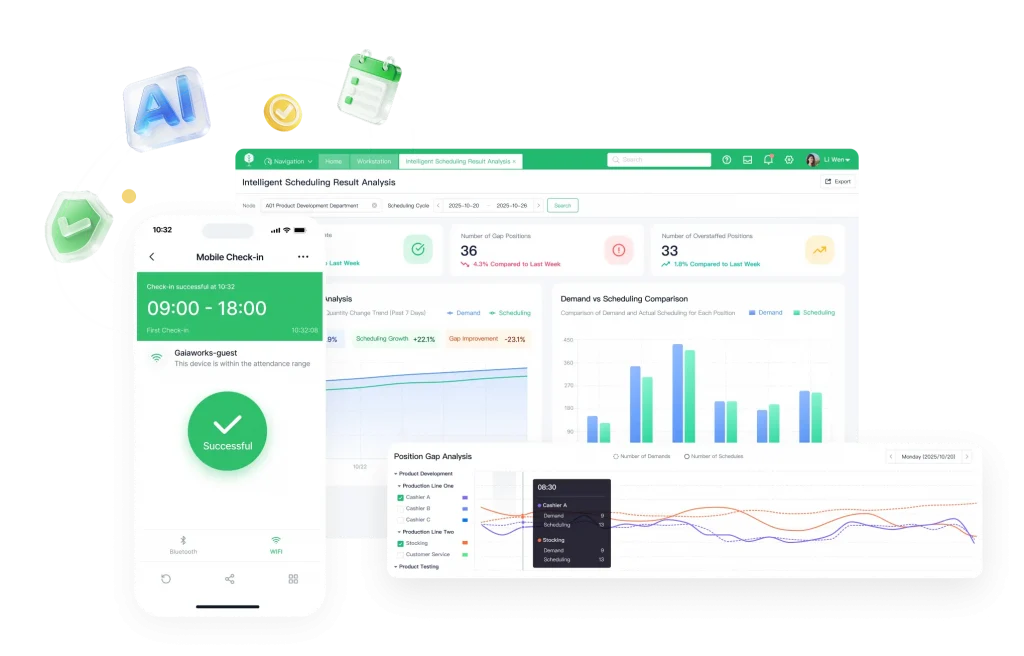
- 2026 Edge: High-end WFM tools have already built the 468 logic into their core. They provide real-time dashboards showing exactly how many hours a casual worker has accumulated over the last 28 days, allowing for Compliance-First Scheduling.
Why GaiaWorks is the Strategic Choice for the 468 Mandate
As a dedicated WFM specialist, GaiaWorks moves beyond simple clock-ins to offer a productivity-first approach:
- Automated 468 Tracking: Our system automatically aggregates hours over the rolling 4-week period, providing instant visibility into which employees have qualified for statutory benefits, eliminating manual Excel errors.
- Smart Rostering & Fatigue Management: We help retail and logistics firms balance the new 68-hour limit against operational needs, ensuring you have the right people on the floor without accidentally over-extending your budget.
- Mobile-First Ecosystem: With the highest smartphone usage in Asia, our App allows Hong Kong workers to check their hours, swap shifts, and view their 468 status in real-time, fostering transparency and trust.
Frequently Asked Questions (FAQ)
Q1: How does the transition from “418” to “468” specifically impact my payroll budget?
A: The 468 Rule makes it easier for casual and part-time staff to qualify for statutory benefits. Historically, an employee working 17 hours a week would not qualify under 418. Now, as long as they hit 68 hours over 4 weeks, they are entitled to holiday pay and annual leave. For high-turnover industries like retail, this could increase labor-related cost if schedules are not optimized.
Q2: Can GaiaWorks track the “rolling 4-week” period automatically, or do we need to reset it monthly?
A: GaiaWorks uses a dynamic rolling window. The system looks back certain days from the current date. This eliminates the reset error common in manual spreadsheets, ensuring you never miss a compliance threshold or accidentally overpay for a status that hasn’t been met.
Q3: Does the 468 Rule apply to “slashers” or freelancers?
A: If the individual is legally classified as an employee (not an independent contractor), the rule applies regardless of their “slasher” status. GaiaWorks helps distinguish these classifications through robust contract management modules, ensuring your T&A (Time & Attendance) data aligns with the correct legal framework.
Q4: Our company uses an existing Global ERP. Why should we integrate GaiaWorks instead of using the ERP’s built-in time-tracking?
A: Most global ERPs are designed for fixed office environments and lack the granularity for Hong Kong’s specific 713 Ordinance (Average Daily Wage) and the new 468 aggregate logic. While global suites excel at core HR data, GaiaWorks act as the Local Calculation Engine, or the “Specialist Layer,” ensuring the last mile accuracy by natively handling complex shift patterns and statutory compliance rules, handling the complex local math and pushing clean, compliant data to your Global ERP via API.
Q5: How long does it take to migrate our manual rosters to the GaiaWorks platform?
A: For a standard enterprise deployment in Hong Kong, GaiaWorks offers a Fast Track plan for standard requirements (Go-live in weeks). This includes system configuration for 468 compliance, hardware integration for biometric/mobile clock-in, and manager training. For complex enterprise rollouts, GaiaWorks adopts a phased approach to ensure zero disruption to your operations.
Empowering Your Workforce Transformation
Navigating the new 468 Rule doesn’t have to be a compliance burden. Ready to transform your operations into a competitive advantage?
Contact Our Experts Today or explore our specialized Time & Attendance and Smart Scheduling solutions to see the GaiaWorks difference.