CUSTOMER STORY
How a 1000+ Seat Service Center Cuts Scheduling Time from 340 to 90 Minutes

29%
Decrease in Shift Swap Rate
Employees get schedules that better reflect stated needs.
3.78x
Improvement in Scheduling Efficiency
Scheduling operation time fell from 340 minutes to 90 minutes.
80%+
Decrease in Dispatch Response Time
Managers are no longer waiting for a manual report to understand whether a peak period is under-staffed.
A leading global ICT enterprise was running customer service operations at scale: more than 1000 agents across its consumer service center and technical support sites.
Service quality at this scale is not a back-office metric. It is a brand metric. Every after-sales call, every complaint resolution, every technical support interaction shapes customer perception of the parent brand. Workforce stability and dispatch efficiency are not supporting functions — they are the operational foundation the service promise depends on.
Before GaiaWorks, one full scheduling cycle took 340 minutes.
That was not a software problem on paper. It was an operations problem in practice.
Service quality at this scale is not a back-office metric. It is a brand metric. Every after-sales call, every complaint resolution, every technical support interaction shapes customer perception of the parent brand. Workforce stability and dispatch efficiency are not supporting functions — they are the operational foundation the service promise depends on.
Before GaiaWorks, one full scheduling cycle took 340 minutes.
That was not a software problem on paper. It was an operations problem in practice.
The Challenge: Scheduling Had Become Too Dependent on Manual Control
The customer service team managed demand patterns that changed by time of day, work order volume, channel workload, leave plans, training sessions, and agent availability. Every service center schedule required judgment. Too much of it lived in people’s heads.
The scheduling process had eight steps: collect demand forecasts, prepare staff lists, match shift rules, process employee requests, generate a draft schedule, review, revise, and confirm. When demand forecasts changed midway, the schedule often had to be rebuilt.
For a 1000+ seat operation, this created three business risks.
First, scheduling was slow. A single cycle took 340 minutes, and the result was still vulnerable to late changes.
Second, schedule fairness was hard to prove. Agents could feel the effect of an unfair schedule immediately, but managers had limited system records to explain why a weekend shift, leave conflict, or swap request had been handled in a certain way.
Without system records, explanations stayed verbal. Verbal explanations do not scale across hundreds of agents and repeated friction points. Over time, that erosion shows up in the metric that matters most: whether experienced agents stay.
Attrition in a contact center costs more than it appears to on paper. Replacing an experienced agent means restarting the recruiting cycle, absorbing training investment, and accepting a service quality dip during the new hire’s ramp-up period. Turnover triggered by scheduling friction is a cost most enterprises never isolate and measure separately — which is part of why it persists.
Third, shift swaps consumed management time. Requests moved through messages, phone calls, and offline coordination. Supervisors had to check whether a swap was possible, find a suitable replacement, confirm availability, and communicate the decision.
There was also a visibility issue. Attendance punctuality, actual headcount by time period, and staffing gaps took up to one hour to compile manually. For a customer service operation, one hour is late. By then, a peak period may already be under-covered.
The scheduling process had eight steps: collect demand forecasts, prepare staff lists, match shift rules, process employee requests, generate a draft schedule, review, revise, and confirm. When demand forecasts changed midway, the schedule often had to be rebuilt.
For a 1000+ seat operation, this created three business risks.
First, scheduling was slow. A single cycle took 340 minutes, and the result was still vulnerable to late changes.
Second, schedule fairness was hard to prove. Agents could feel the effect of an unfair schedule immediately, but managers had limited system records to explain why a weekend shift, leave conflict, or swap request had been handled in a certain way.
Without system records, explanations stayed verbal. Verbal explanations do not scale across hundreds of agents and repeated friction points. Over time, that erosion shows up in the metric that matters most: whether experienced agents stay.
Attrition in a contact center costs more than it appears to on paper. Replacing an experienced agent means restarting the recruiting cycle, absorbing training investment, and accepting a service quality dip during the new hire’s ramp-up period. Turnover triggered by scheduling friction is a cost most enterprises never isolate and measure separately — which is part of why it persists.
Third, shift swaps consumed management time. Requests moved through messages, phone calls, and offline coordination. Supervisors had to check whether a swap was possible, find a suitable replacement, confirm availability, and communicate the decision.
There was also a visibility issue. Attendance punctuality, actual headcount by time period, and staffing gaps took up to one hour to compile manually. For a customer service operation, one hour is late. By then, a peak period may already be under-covered.
Why GaiaWorks
The enterprise was not looking for a long feature list. It needed proven intelligent scheduling execution at service-center scale.
The decision criteria were practical:
· Support for complex shift rules across 1000+ agents
· Employee self-service for shift preferences, leave, and swap requests
· Manager approval workflows with records and time stamps
· Fast rescheduling when demand forecasts changed
· Real-time visibility into planned versus actual staffing
· A structure that could support local labor rules without locking the operation into one country-specific model
That last point mattered. Labor rules are a baseline requirement, not the story. The stronger value is that a workforce management platform can encode different working-time rules, approval logic, rest requirements, indirect hours, and audit records into one operating model.
For global and APAC enterprises, this is where compliance becomes an engineering advantage. The system must be flexible enough to support local rules while keeping scheduling, staffing, and workforce data consistent across sites.
The decision criteria were practical:
· Support for complex shift rules across 1000+ agents
· Employee self-service for shift preferences, leave, and swap requests
· Manager approval workflows with records and time stamps
· Fast rescheduling when demand forecasts changed
· Real-time visibility into planned versus actual staffing
· A structure that could support local labor rules without locking the operation into one country-specific model
That last point mattered. Labor rules are a baseline requirement, not the story. The stronger value is that a workforce management platform can encode different working-time rules, approval logic, rest requirements, indirect hours, and audit records into one operating model.
For global and APAC enterprises, this is where compliance becomes an engineering advantage. The system must be flexible enough to support local rules while keeping scheduling, staffing, and workforce data consistent across sites.
What Changed After Implementation
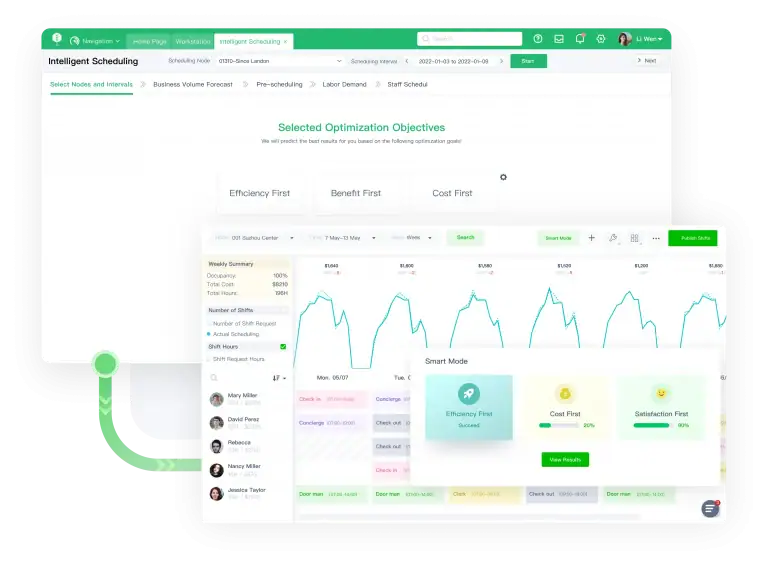
After GaiaWorks went live, the scheduling workflow was reduced from eight steps to four.
The bigger change was not the number of steps. It was the ownership of rules.
Before, schedulers had to manually collect demand, check employee preferences, remember constraints, and build the schedule through repeated review. After implementation, demand requirements could be collected into the system, employee preferences and rest rules could be entered up front, and the scheduling engine could generate the first draft.
When demand changed, the system could regenerate a plan using updated inputs. The scheduler no longer had to start from zero.
Shift swaps also moved from informal coordination to a tracked workflow. Employees could submit swap and leave requests through self-service. Managers could approve them online. The process became visible, recorded, and easier to control.
The bigger change was not the number of steps. It was the ownership of rules.
Before, schedulers had to manually collect demand, check employee preferences, remember constraints, and build the schedule through repeated review. After implementation, demand requirements could be collected into the system, employee preferences and rest rules could be entered up front, and the scheduling engine could generate the first draft.
When demand changed, the system could regenerate a plan using updated inputs. The scheduler no longer had to start from zero.
Shift swaps also moved from informal coordination to a tracked workflow. Employees could submit swap and leave requests through self-service. Managers could approve them online. The process became visible, recorded, and easier to control.
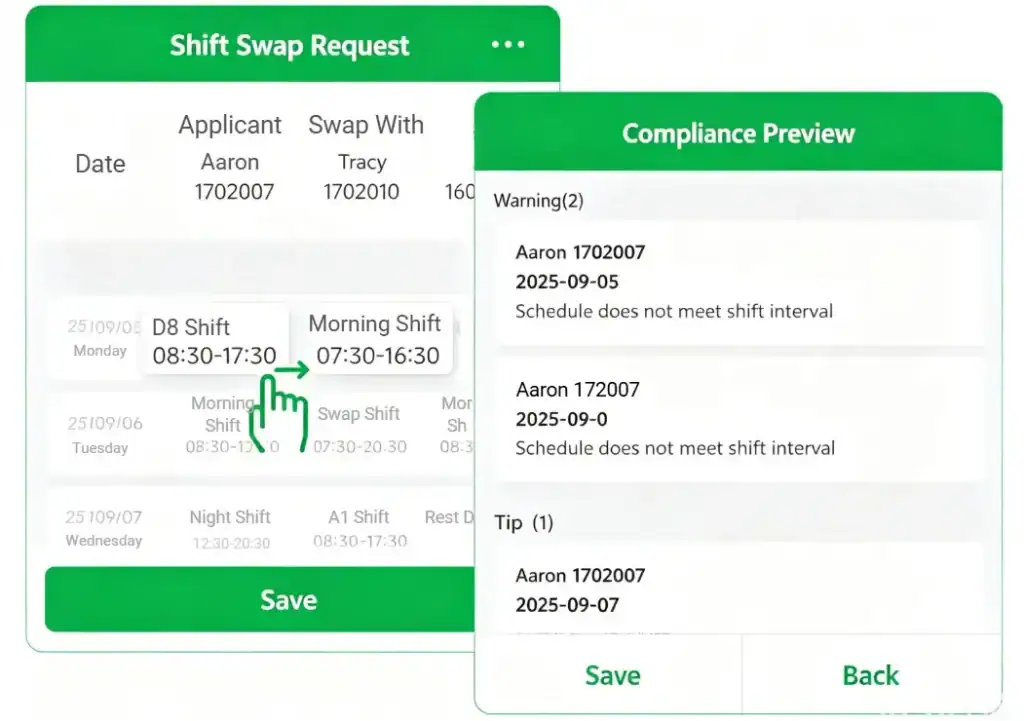
More importantly, GaiaWorks helped the team reduce swap demand at the source. By collecting preferences and rest needs before schedule generation, the system could consider reasonable employee requirements earlier instead of pushing every conflict into post-schedule negotiation.
Training, coaching, same-team shift rules, and other non-production arrangements were also managed inside the same scheduling structure. Direct and indirect working time became easier to analyze.
For working-time governance, the approach aligns with the broader principle recognized by the International Labour Organization: working time is not only a compliance topic, but also a core factor in health, productivity, and work organization. See the ILO’s reference on working time and work organization.
The Results
After implementation, the enterprise compared its operating state before and after GaiaWorks.
Scheduling operation time fell from 340 minutes to 90 minutes.
That is a 3.78x improvement in scheduling efficiency.
Shift swap rate decreased by 29%.
Dispatch response time — the speed at which managers detect and correct a real-time staffing gap — improved from 60 minutes to 10 minutes.
These are not cosmetic gains. For a large customer service operation, they change how managers spend their day.
Schedulers can focus more on exception handling and rule improvement, instead of repeatedly rebuilding schedules by hand. Supervisors handle fewer avoidable swaps. Employees get schedules that better reflect stated needs. Operations leaders see staffing gaps earlier and can act before service pressure becomes visible to customers.
The 50-minute improvement in dispatch response is especially important. It means managers are no longer waiting for a manual report to understand whether a peak period is under-staffed. They can compare scheduled headcount with actual attendance close to real time and adjust before the service level is at risk.
Scheduling operation time fell from 340 minutes to 90 minutes.
That is a 3.78x improvement in scheduling efficiency.
Shift swap rate decreased by 29%.
Dispatch response time — the speed at which managers detect and correct a real-time staffing gap — improved from 60 minutes to 10 minutes.
These are not cosmetic gains. For a large customer service operation, they change how managers spend their day.
Schedulers can focus more on exception handling and rule improvement, instead of repeatedly rebuilding schedules by hand. Supervisors handle fewer avoidable swaps. Employees get schedules that better reflect stated needs. Operations leaders see staffing gaps earlier and can act before service pressure becomes visible to customers.
The 50-minute improvement in dispatch response is especially important. It means managers are no longer waiting for a manual report to understand whether a peak period is under-staffed. They can compare scheduled headcount with actual attendance close to real time and adjust before the service level is at risk.
What This Means for Frontline Workforce Operations
The project now covers all seats across the customer service center’s owned service lines and technical support sites, with expansion to additional business lines planned.
The lesson is straightforward.
At enterprise scale, scheduling is no longer an administrative task. It is an operating control point.
When scheduling depends on manual coordination, every rule, preference, leave request, training plan, and demand change adds friction. When those rules are structured inside a workforce management system, the operation gains speed, transparency, and repeatability.
For labor-intensive enterprises across APAC and global markets, that matters. The goal is not simply to make a schedule faster. The goal is to protect service quality, reduce avoidable coordination cost, support fairer workforce practices, and give managers a clearer view of the business while there is still time to act.
Ready to make scheduling a stronger operating control point? See GaiaWorks’ intelligent scheduling solution.
A Great Workforce, Gaia Works.
The lesson is straightforward.
At enterprise scale, scheduling is no longer an administrative task. It is an operating control point.
When scheduling depends on manual coordination, every rule, preference, leave request, training plan, and demand change adds friction. When those rules are structured inside a workforce management system, the operation gains speed, transparency, and repeatability.
For labor-intensive enterprises across APAC and global markets, that matters. The goal is not simply to make a schedule faster. The goal is to protect service quality, reduce avoidable coordination cost, support fairer workforce practices, and give managers a clearer view of the business while there is still time to act.
Ready to make scheduling a stronger operating control point? See GaiaWorks’ intelligent scheduling solution.
A Great Workforce, Gaia Works.