
Scaling Multi-Site Retail: Standardizing Scheduling and Attendance Across 100+ Outlets

Reported network-level reduction in weekly store schedule-building effort.
Reported compliance with the project’s configured cumulative labor-hour rules.
Reported coverage of mission-critical roles under configured staffing rules.
Published project outcomes. Results may vary by operating model, data quality, configuration, and local labor rules.
The Scaling Inflection Point
The legacy environment was built on fragmented local tools and could no longer support retail labor planning at this scale. Labor inefficiencies began eroding store-level margins, while compliance risks became harder to control. The retailer needed a standardized and highly configurable Retail Scheduling and Attendance System system to protect brand reputation, stabilize store labor costs, and align floor capacity with volatile omnichannel demand.
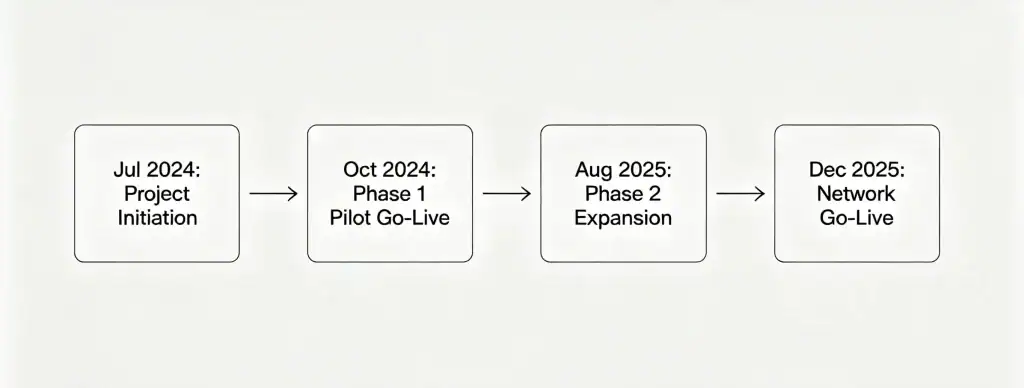
To remove this bottleneck, the chain integrated the globally scalable workforce infrastructure from GaiaWorks. By March 2026, the platform was in stable operation across the network, supporting agile frontline workforce operations in one of the world’s most demanding retail environments.
Managing Quarterly Working-Hours Capacity Without an End-of-Period Crunch
Store managers often scheduled core employees heavily during the early weeks of a quarter to maintain service levels. This front-loaded scheduling pattern consumed legal working-hour capacity too early. By the final month, many employees had little or no legal working-hour capacity remaining. This created an end-of-quarter staffing crunch, forcing stores to cut employee hours, rely on expensive last-minute temporary labor, or face potential non-compliance penalties. Managing this risk manually across more than 100 stores had become an unsustainable administrative burden.
Store-Level Operational Friction
The Administrative Scheduling Burden
Because scheduling was entirely manual, errors were common. Overlapping shifts, double-booked employees, and violations of mandatory rest periods occurred regularly. These issues created employee frustration, increased turnover risk, and left stores understaffed during peak operating windows. When an error appeared, managers often had to rebuild large portions of the schedule manually, creating further delays.
O2O Omni-Channel Demand Volatility
O2O order volume does not follow a stable daily pattern. Demand can spike suddenly around mealtimes, during local weather events, or in response to digital promotions. Without an automated way to translate demand into labor requirements, store managers scheduled picking and packing staff based on static historical averages or personal judgment. This led to two costly outcomes:
· During peak order spikes: The picking lines were understaffed. Order queues backed up, delivery SLA agreements were breached, and customer satisfaction fell.
· During low-volume lulls: Excess picking staff remained on the floor with no tasks to complete, resulting in direct margin leakage.
Limited Executive Visibility
Operational data reached headquarters through manual weekly or monthly reports. By the time corporate planners reviewed the data, it was often too late to identify inefficiencies, correct over-scheduling, or intervene before a store approached its quarterly labor-hour limit. Without a unified database, comparing the efficiency of different store formats was also difficult.
How GaiaWorks Automates Retail Scheduling, Attendance, and Labor Compliance
Core Architecture Pillars
The GaiaWorks deployment moved the retailer from manual Excel-based planning to a centralized workforce operating system built around five core pillars:
- Multi-Dimensional Labor Control: Tracks cumulative working hours dynamically across day, week, month, and quarter views to prevent end-of-quarter scheduling crunches.
- O2O Predictive Scheduling: Connects directly via API to the O2O dispatch system to model labor demand hour-by-hour.
- Recommended shift templates: Preserves established store routines through pre-configured shift patterns, accelerating manager adoption.
- System-Enforced Coverage Rules: Applies configured coverage rules for essential role (100% saturation for Duty Managers, Bakery, and Night Crews).
- Plain-language exception guidance: Translates backend mathematical constraint failures into clear, actionable instructions for store managers.
Multi-Dimensional Dynamic Labor Hour Control
The system calculates each full-time and part-time employee’s quarterly labor-hour balance in real time. When the scheduling engine runs, it prioritizes employees with the highest remaining quarterly capacity. This balancing logic prevents managers from front-loading employee hours early in the quarter and creating a capacity shortage later.
To make the data practical for store teams, GaiaWorks embedded a real-time visual dashboard directly into the schedule-building interface. Managers do not need to leave the scheduling screen or run separate reports. The dashboard shows each employee’s quarterly hour limit, scheduled hours, and remaining capacity through a clear, color-coded view.
If a manager tries to assign a shift that would push an employee beyond the quarterly threshold, the system blocks the action immediately. This prevents compliance risks before they become operational problems.
Hourly O2O Demand Forecasting Engine
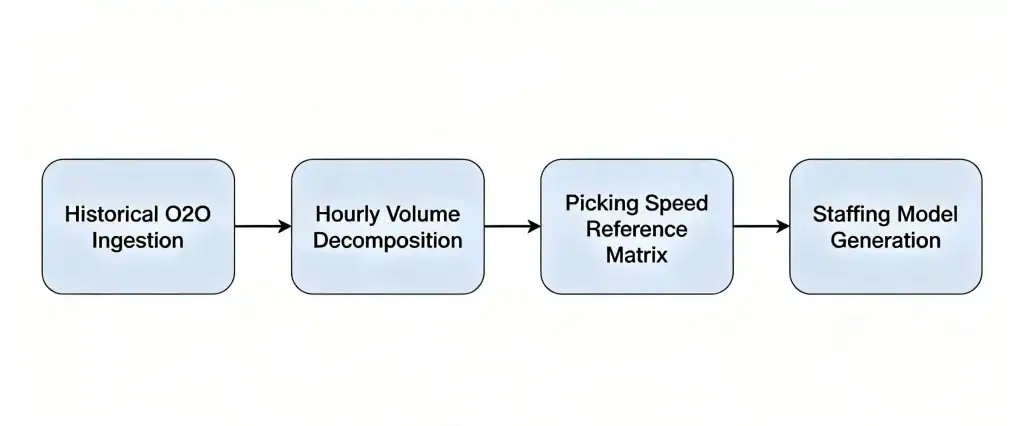
1. Temporal Decomposition: The system analyzes historical order trends to project future volume, breaking down daily demand into 60-minute operational windows.
2. Labor Standards Translation: The engine applies the retailer’s standardized productivity benchmarks (e.g., standard items picked and packed per worker per hour) to convert raw order volume projections into exact, hourly FTE (Full-Time Equivalent) requirements.
3. Algorithmic Shift Generation: The system schedules higher picking capacity during high-volume windows and reduces scheduled hours during slower periods.
To optimize labor costs, the system assigns lower-cost part-time and contract staff to cover high-volume O2O picking spikes, while keeping core full-time staff focused on standard store operations.
Operational Habit Calibration (Recommended Shifts)
Stores can pre-configure their preferred and historically proven shift patterns in the system. When the scheduling engine generates a schedule, it prioritizes these approved templates wherever possible.
By aligning optimization logic with familiar store routines, the retailer reduced disruption, accelerated user adoption, and minimized manual corrections after schedule generation. Managers retained a sense of operational control, while the system continued to enforce legal, coverage, and cost constraints in the background.
System-Enforced Coverage Rules
Store operations are classified into two distinct priority tiers:
1. Critical coverage roles (Hard Constraints): Duty managers, in-store bakery teams, and 24-hour night-stocking crews are treated as hard constraints. The scheduling engine is configured to flag coverage gaps or excess staffing for these roles before schedules are published.
2. Flexible operational tasks (Soft Constraints): General floor maintenance, aisle restocking, and similar tasks are treated as flexible constraints. Staffing for these roles can scale up or down based on remaining labor budget and forecasted traffic.
This prioritization helps managers protect coverage for core, revenue-generating, and safety-critical store functions, while allowing non-essential labor to flex with forecast demand and available capacity.
Plain-Language Exception Guidance
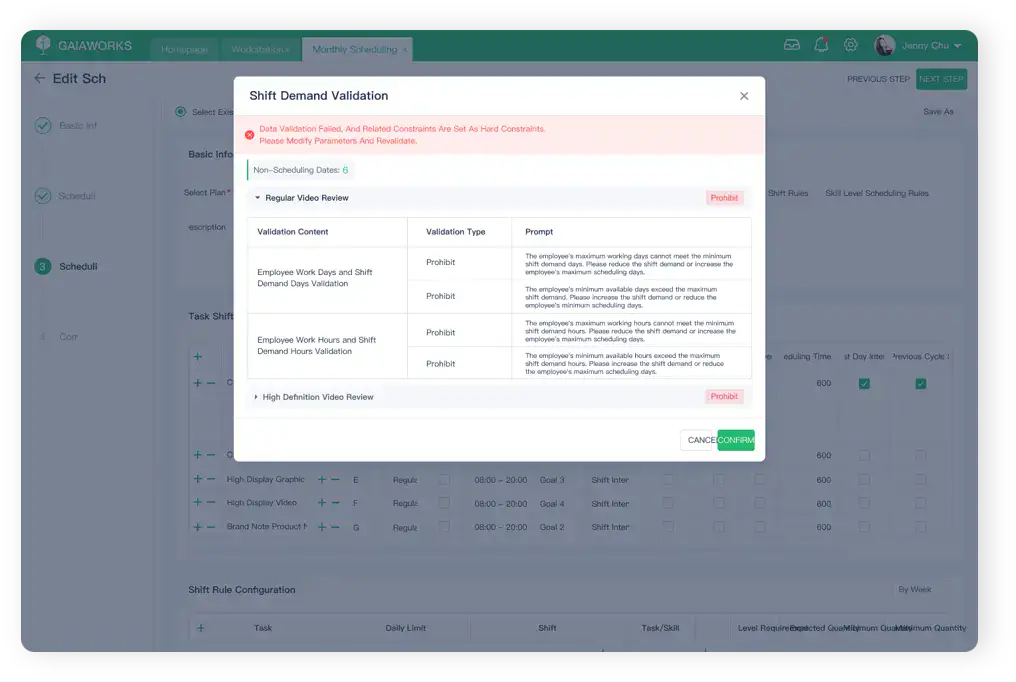
When a schedule cannot be validated—for example, if a manager attempts to assign a shift that violates rest-period laws—the system does not display cryptic technical error codes. Instead, it translates the mathematical conflict into clear, conversational business terms.
The interface highlights the exact conflict on the screen, identifies the specific employee, rule, or task causing the issue, and provides recommended resolutions. This feature allows store managers to troubleshoot schedules independently, eliminating the need for IT intervention.
Strategic Business Outcomes and Regional ROI
92% Scheduling Efficiency Gain
| Outcome | Before deployment | After deployment | Published result |
|---|---|---|---|
| Established-store scheduling | 3–4 hours per week | Under 10 minutes per store | About 95% time saved |
| New-store scheduling | 4–6 hours per week | Under 10 minutes per store | About 97% time saved |
| Network scheduling efficiency | Manual scheduling process | Recommended templates and automated scheduling | 92% reported gain |
| Quarterly labor-hour compliance | Manual monitoring across stores | Configured tracking and pre-emptive schedule controls | 100% reported compliance |
| Core task fulfillment | Not centrally enforced | Configured critical-role coverage rules | 95%+ reported fulfillment |
Measurement note: Scheduling-time figures compare the reported manual schedule-building time for a typical store team of 30–40 employees with the reported time after deployment. Compliance and fulfillment results refer to the project’s configured rules and reported measurement period; they are not a legal certification or universal performance guarantee.
100% Quarterly Labor Compliance
During the reported measurement period, the retailer achieved 100% compliance with the working-hour rules configured for applicable roles under its quarterly calculation cycle. Earlier visibility of remaining capacity also helped managers reduce reliance on last-minute emergency agency labor at the end of fiscal quarters.
95%+ Core Task Fulfillment
Additionally, by integrating the system with the O2O order database, the retailer aligned picking capacity with real-time demand. This reduced delivery service-level breaches during peak order windows and minimized idle labor during slower periods.
Standardizing Workforce Operations Across Complex Retail Markets
The GaiaWorks deployment shows how a centralized, data-driven scheduling engine can transform workforce management from a decentralized administrative task into a scalable operating capability. By replacing manual effort and preventable errors with real-time constraint tracking, predictive demand modeling, and clear guidance for managers, the retailer protected margins, reduced compliance exposure, and built a workforce framework ready to support its next stage of regional growth.
A Great Workforce, Gaia Works.
FAQ
What is front-loaded scheduling in retail?
Front-loaded scheduling happens when store managers assign too many employee hours early in a labor-control period. In a rolling three-month labor-hour framework, this can leave employees with too little legal working-hour capacity near the end of the quarter, creating understaffing and compliance risks.
How does quarterly labor-hour compliance affect supermarket scheduling?
Quarterly labor-hour compliance requires retailers to monitor employee working hours across a longer rolling window, not just by day or week. Without automated tracking, managers may unknowingly exhaust employee capacity too early and trigger end-of-quarter staffing shortages.
How can workforce management software reduce retail scheduling time?
Workforce management software can automate shift generation, apply labor rules in real time, and flag scheduling conflicts before schedules are published. In this case, GaiaWorks reduced weekly schedule generation from three to six hours to under 10 minutes per outlet.
How does O2O grocery delivery affect store labor planning?
O2O grocery delivery creates volatile in-store labor demand because employees must pick, pack, and stage online orders from physical stores. Demand often spikes around mealtimes, weather events, and digital promotions, requiring hour-by-hour labor forecasting rather than static scheduling.