The Frontline Data Loop: Feeding the Superintelligent Enterprise at Workday Elevate Hong Kong 2026
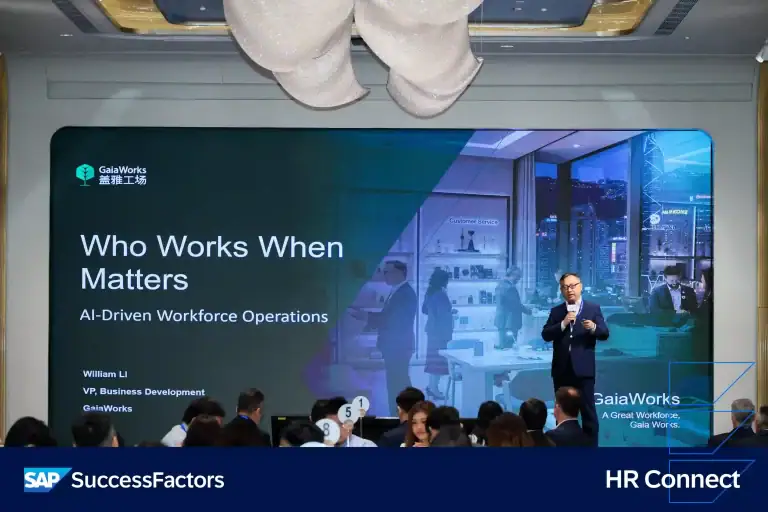
At the Rosewood Hong Kong last week, Workday Elevate 2026 laid out an ambitious blueprint for the future of work. The central theme was clear: the enterprise of the future will move past isolated AI experimentation to deploy AI at scale. Through the introduction of “Sana”—a superintelligence platform designed to orchestrate AI agents across the IT stack—the event painted a compelling picture of a harmonious, data-driven workplace. Keynotes from regional leaders at Prudential and Mandarin Oriental emphasized a transition toward organizational agility, where technology serves as a proactive teammate rather than a threat. This highlights the growing need for agility in frontline operations.
Yet, for organizations operating in labor-intensive industries such as retail, hospitality, and property management across the Asia-Pacific region, a critical architectural question remains. How does this high-level enterprise superintelligence connect with the chaotic, high-frequency operational reality of the shop floor, the kitchen, or the residential lobby?
During the HR breakout tracks, Kunal Mulchandani, Director of Human Resources at the English Schools Foundation (ESF), introduced a guiding principle that answers this question: “Context Before Content.”
Before an enterprise can deploy intelligent agents to optimize its workforce, it must first capture the precise, real-time “micro-context” of its operations. If the daily transactional data of the frontline—who is qualified, who is available, who actually clocked in, and under what regional constraints—remains trapped in fragmented Excel spreadsheets and WhatsApp messages, the superintelligent enterprise has an operational blind spot its daily frontline operations.
The Friction at the Edge: Bridging Global AI with Frontline Operations
Global core Human Capital Management (HCM) systems serve as the indispensable database of record for corporate master data, organizational structures, and global talent pipelines. They are built for stability, governance, and long-term planning.
However, they are not designed to handle the volatile, millisecond-by-millisecond transaction volume of frontline shift work.
A static database cannot resolve a sudden shift vacancy at 6:00 AM in a retail store, nor can it dynamically recalculate complex regional overtime premiums on the fly. When organizations attempt to force their global core platforms to manage these high-frequency operational variables, they face two distinct bottlenecks in their frontline operations:
- Administrative Fatigue: Branch and store managers spend up to 20% of their week manually building rosters, managing shift swaps over chat apps, and consolidating physical timesheets.
- The Customization Trap: Attempting to customize a global HCM to calculate hyper-local labor laws, specialized shift premiums, and compliance variances (such as Hong Kong’s 417/468 continuous contract rules) results in prohibitive development costs and brittle software architecture.
This is where specialized Rostering & Attendance software becomes the critical missing link in the enterprise architecture. GaiaWorks does not replace the global core HCM; we extend its capabilities to the deskless workforce. As an independent Workforce Management (WFM) product specialist and a certified Workday Sales & Service Delivery Partner, we provide the specialized transaction engines that turn frontline operational chaos into structured, audit-ready data.
+-----------------------------------------------------------------------------+
|                                GLOBAL ENTERPRISE CORE                                                |
|          (Workday: Master Data, Global Talent, Core HR Governance)                |
+-----------------------------------------------------------------------------+
                                             ▲
                                             │  OpenAPI Connectivity:
                                             │  Gross-Pay Ready Data
                                             ▼
+-------------------------------------------------------------------------------+
|                          LOCAL OPERATIONS ENGINE                                                        |
|    (Gaia WFM: Smart Scheduling, Real-Time Rostering, Attendance Tracking)   |
+-------------------------------------------------------------------------------+
                                              ▲
                                              │  Real-Time Frontline
                                              │  Execution & Input
                                              ▼
+-----------------------------------------------------------------------------+
|                           THE DESKLESS FRONT LINE                                                     |
|       (Hourly Workers, Shift Swaps, Mobile Clock-ins, Local Guardrails)           |
+-----------------------------------------------------------------------------+
Silently Embedded Guardrails: Shifting Compliance from Audit to Execution
A prominent theme during the Innovation Track at Workday Elevate—specifically addressed in Deloitte’s session on “Delivering AI Impact at Enterprise Scale”—was the necessity of embedding governance directly into automated workflows. AI and automation cannot operate in a regulatory vacuum; they must be guided by secure, deterministic guardrails.
For regional enterprises, compliance is a massive operational headache, but it is rarely a pain point that frontline managers actively monitor. A retail store manager’s primary goal is to cover their shift schedule, not to manually audit the rolling four-week accumulated hours of a part-time employee to prevent triggering Hong Kong’s 417/468 continuous contract thresholds.
To bridge this, GaiaWorks silently embeds local compliance checks directly into the scheduling and attendance workflow of daily frontline operations. The intelligence must reside inside the daily tool, not in a post-event audit report.
When a manager attempts to assign a shift that would violate rolling-hour limits or local rest-day mandates, the scheduling engine flags the compliance anomaly in real time. Because these rules are processed programmatically at the point of scheduling, compliance becomes an invisible safety net. The business is protected from costly labor violations automatically, long before the data ever reaches the payroll stage.
Transforming Raw Attendance into Gross-Pay Ready Data
The core value proposition of a modern WFM platform lies in its ability to streamline the path from an employee’s physical clock-in to their final payslip.
By utilizing Gaia Time & Attendance alongside Gaia Smart Scheduling, companies replace manual data reconciliation with an automated pipeline. Our platform captures multi-modal attendance data (via secure mobile applications, geofenced location tags, or IoT devices) and processes it against localized shift rules, meal breaks, and holiday premiums.
The output is Gross-Pay Ready Data. Through standard, open API connectivity, this highly accurate, pre-calculated operational data flows directly back into global core payroll and HCM engines.
This clean division of labor ensures that the parent organization maintains a unified, centralized global system of record, while local operating units retain the absolute flexibility and speed required to run their businesses on the ground.
Proving the Value: Measurable Outcomes Across APAC Sectors
As discussed throughout the Workday Elevate panels, digital transformation is measured by real, repeatable outcomes, not pilot programs. GaiaWorks’ deployment of this integrated WFM architecture has delivered clear ROI across key APAC industries:
- Retail Operations: An international luxury jewelry group operating across Greater China integrated Gaia’s smart scheduling with real-time POS traffic data. This integration reduced store managers’ administrative scheduling time by 80%, shifting their daily focus from manual Excel-based administration to active customer engagement during peak hours.
- Property Management: A premier regional real estate developer integrated our real-time attendance and rostering engine with their central ERP system. By embedding local compliance guardrails across properties in Hong Kong and mainland China, the developer eliminated manual cross-border timesheet audits and minimized compliance anomalies.
- Quick-Service Restaurants (QSR): A global QSR brand leveraged automated rostering and dynamic scheduling to coordinate multi-skilled crews across high-volume meal rushes. The automation improved wage-calculation accuracy to 99%, yielding over HKD 100 million in annual operational savings through optimized labor deployment and reduced idle hours.
The Connected Future
Achieving enterprise superintelligence requires connecting your highest-level corporate strategies with your most granular frontline actions. By partnering a robust global core system with a specialized, highly adaptable frontline scheduling and attendance engine, modern enterprises protect their operating margins, secure complete compliance, and empower their workforce.
A Great Workforce, Gaia Works.