2026 Global Workforce Management White Paper
Global workforce management requires local rule depth. This white paper offers a practical view of cross-border workforce compliance, productivity, and employee experience, with country-level insights for 14 markets.
Published by GaiaWorks. This white paper is provided for general informational purposes and does not constitute legal or professional advice.
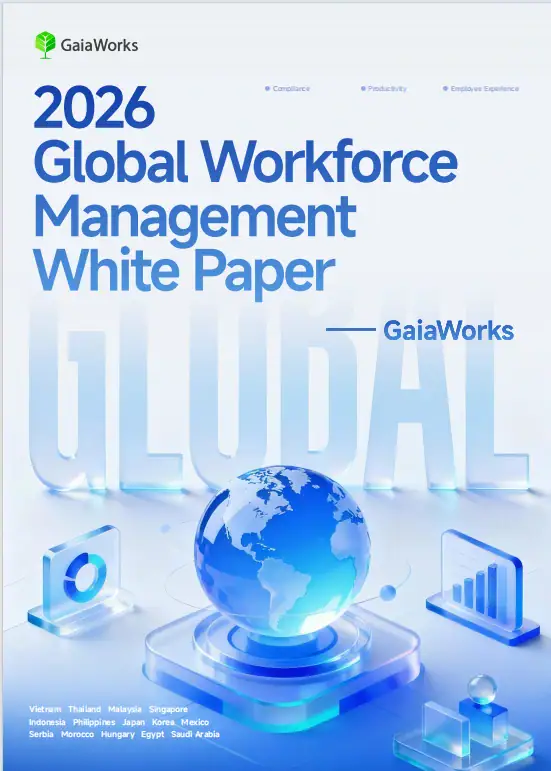
A report for the move from market entry to localized operations.
The white paper connects global workforce governance with the daily realities of frontline operations: working time, scheduling, attendance, overtime, leave, payroll inputs, data protection, and employee experience.
Scope and coverage notes are based on the white paper, with data stated as current as of December 2025 and continuously updated.
Global visibility is useful only when local rules can run.
Global expansion is moving from market entry to localized operations. Multinational employers increasingly need to manage frontline work across different labor rules, public holidays, working-time requirements, data privacy frameworks, languages, currencies, and time zones.
The 2026 Global Workforce Management White Paper examines how enterprises can maintain a common operating view while adapting daily workforce processes to local requirements. It focuses on the connection between policy and execution, where scheduling, attendance, overtime, leave, payroll preparation, data governance, and employee experience meet.
Standardize the governance, data definitions, visibility, and controls headquarters needs. Localize the rules, calendars, workflows, and approvals frontline operations need.
The six core challenges of global workforce management
The report frames global workforce management around the operational questions that become harder as organizations expand across markets, sites, cultures, and regulatory systems.
Localization
Adapt language, currency, time zones, calendars, and employee workflows to local operating conditions.
Workforce Compliance
Translate working-time, overtime, leave, holiday, attendance, and labor-law requirements into executable workforce rules.
Data Governance & Privacy
Manage workforce data protection, access, security, retention, and cross-border transfer requirements.
Global Governance
Aggregate and interpret workforce data while local teams retain the control needed for daily operations.
Cross-Cultural Integration
Support transparency, flexibility, autonomy, and employee engagement while respecting local conditions.
Operational Efficiency
Improve labor utilization and workforce productivity without relying only on additional working hours.
A practical framework for cross-border workforce decisions.
The report is structured to help leaders move from a broad globalization question to the workforce rules, governance choices, and country-level considerations that shape implementation.
2026 strategic outlook
Understand why global workforce management becomes more operationally important as enterprises move toward deeper localized operations and more complex workforce models.
Compliance toolkit
Review the workforce management compliance model, self-assessment approach, global compliance map, and compliance management system concept described in the white paper.
Country-level insights
Explore labor and data protection considerations across selected overseas expansion markets, together with examples of workforce management implementation.
Selected markets, with more country profiles in the report.
The white paper includes 14 country profiles. The page highlights selected markets so visitors can quickly understand the geographic scope without turning the landing page into a full country index.
What the country profiles cover
Depending on the market, the country sections examine minimum wage, public holidays, working hours, overtime, statutory leave, personal data protection, and cross-border data considerations. Requirements should be validated against current official guidance before implementation.
For leaders responsible for distributed frontline work.
This report is intended for organizations managing workforces across multiple entities, sites, countries, or operating models, especially where labor decisions affect service delivery, operating cost, and workforce stability.
Questions this report helps you evaluate.
A global workforce management program requires more than a common reporting layer. It requires a clear view of which decisions should be standardized and which rules must remain local.
Compliance, productivity, and employee experience belong in the same operating conversation.
Global workforce management is strongest when global visibility and local agility are designed together.GaiaWorks | Publisher of the 2026 Global Workforce Management White Paper
What leaders usually need to clarify first
How can multinational employers manage different labor rules across multiple markets?
What should headquarters standardize, and what should local teams control?
What should HR, payroll, finance, and IT evaluate in a global WFM system?
Which countries and regions are covered in the white paper?
Does this white paper provide legal or payroll advice?
Get the 2026 Global Workforce Management White Paper.
Complete the form to access the white paper and receive practical insights from GaiaWorks on global workforce management, local compliance, and frontline workforce operations.
The form below is reserved for the approved GaiaWorks Forminator experience. Do not replace the shortcode with a second form.
Download the White Paper